

Agoda and GSTC Launch Accessibility Training in Thailand: What Hostel Operators Can Learn
The short version: Most trend lists are written for investors and conference slides. The ones worth your attention in 2027 are the shifts that change who finds you, who stays, how long, and what they will pay for; the rest is noise with a logo.
A note on trend-spotting
Every January, the industry produces a fresh stack of trend reports. Many are useful. Some are a single anecdote wearing a lanyard. The honest position for any operator is skepticism plus curiosity: watch what is changing in your own booking data, ask other operators what they are seeing, and treat confident market forecasts as hypotheses.
What follows are informed observations and open questions, not predictions with decimal points. Where public data exists, we flag it for checking. Where it does not, we say so.
1. AI shortlists are the new front door
For years, the discovery funnel looked familiar: search engine, OTA, maybe a review site, booking. Increasingly, travelers ask an AI assistant something like "best social hostel in Lisbon under 40 euros with a good kitchen" and get back three names. Not thirty. Three.
That changes the game. If you are not in the shortlist, you are not in the consideration set at all. And these systems appear to draw on what is written about you across the web: your own site, review text, listings, articles, forum mentions.
What operators can reasonably do:
- Make your own website say clearly and specifically what you are: location, room types, price range, vibe, facilities, who you are for. Vague copy is invisible to machines and humans alike.
- Keep listings consistent across platforms. Conflicting information makes you look less reliable to everyone.
- Encourage detailed reviews. "Great!" helps less than "great kitchen, quiet dorms, staff organized a free walking tour."
- Get mentioned in credible places: local guides, travel writers, community forums.
Open question: how will this affect OTA dependence? AI tools may surface direct websites more often, or they may simply hand traffic to whoever has the cleanest structured data. Probably both, depending on the tool. Watch your referral sources: your own analytics will tell you more about this than any industry headline.
2. Private rooms and the hybrid hostel
The 12-bed dorm is not dead, but it is no longer the whole business. Many hostels have expanded private rooms, ensuites and small family rooms, while keeping the social spaces that make a hostel a hostel. The result is a hybrid: hotel-ish privacy, hostel-ish community.
Why it matters: privates can broaden your guest mix (couples, older travelers, small groups, remote workers) and often carry higher revenue per square meter. They also bring higher expectations on cleanliness, noise and amenities.
The wink: if you add privates, guests will start comparing you to budget hotels. Make sure your common room is a reason to choose you over them. Nobody ever wrote "amazing atmosphere" about a hotel corridor.

3. Digital nomads and longer stays
Remote work did not vanish when offices reopened. A meaningful number of people still travel while working, and some countries now court them actively with remote work visas. Spain is one example: as of this writing, the Spanish consulate's Digital Nomad Visa page describes a residence visa for people working remotely for employers or clients based outside Spain. Rules change often, so check official sources for any country you market to. For hostels, that suggests demand for weekly and monthly stays, especially in shoulder and low seasons.
Longer-stay guests want different things: reliable Wi-Fi with real upload speeds, a desk or quiet workspace, good kitchens, laundry, and housemates who are not starting the party on a Tuesday. They also change the community dynamic, often for the better, as long-stayers become informal hosts for new arrivals.
Questions to ask yourself: do you price long stays on purpose, or by accident? Do you have a policy for when a long-stayer becomes, in practice, a tenant? Local rules on short-term versus residential occupancy may apply, and the point at which a guest gains tenant rights differs by jurisdiction, so ask a local lawyer before you offer monthly beds.
4. The direct booking push, again, but smarter
Every year someone declares this the year of direct booking. Most years, OTAs still deliver most of the bookings for many hostels. Both things can be true.
The more interesting shift is in how operators approach it. Rather than fighting OTAs, many treat them as discovery channels and work on converting second visits, group bookings and long stays to direct. Tactics that tend to be discussed:
- A booking engine that works properly on a phone.
- Clear perks for booking direct: flexible cancellation, a free breakfast, early check-in.
- Email and messaging to past guests.
- Packages that OTAs cannot easily replicate: NYE plus brunch, a week with a surf lesson.
Be careful with channel contracts. Some OTA agreements have had rate parity provisions, and the rules around them differ by market. In the EU, the European Commission states that from 14 November 2024, under the Digital Markets Act, accommodation providers on Booking.com are free to offer better prices and conditions on other channels, including their own websites. That is the position as of this writing; elsewhere, read your contract.
5. Asia and Latin America come into focus
The center of gravity of hostel development has been broadening. Southeast Asia has a long-established backpacker circuit, and Latin America, including Mexico, Colombia and Peru, has well-traveled backpacker routes of its own, served by a mix of independent hostels and small chains. Domestic travel in these regions also matters, not only international backpackers.
For operators elsewhere, this matters in two ways. First, competition for the long-haul traveler is global: a backpacker choosing between Europe and Southeast Asia is comparing value, not just price. Second, there are lessons to borrow, from hostel brands that have built strong social programming and design-led spaces at modest price points.
For operators in these regions, the question is less "will the market grow" and more "what kind of growth": local ownership, community ties, and sustainable tourism, or a rush of identical properties competing on price.
6. Staffing models are being rethought
Staffing has been one of the industry's most discussed pain points: recruitment, retention, wages, and the long-standing reliance on volunteers and work-exchange arrangements. Several pressures are converging:
- Labor law scrutiny of volunteer arrangements. As of this writing, GOV.UK says a UK volunteer who gets any payment, reward or benefit in kind beyond expenses may be treated as an employee or worker, and Australia's Fair Work Ombudsman says unpaid work outside a student placement is only allowed where there is no employment relationship, even if the person is called a volunteer.
- Rising wage costs in many markets.
- Technology handling more of the routine work: self check-in, keyless entry, automated messaging, smarter housekeeping schedules.
The likely outcome is not "robots replace receptionists." It is fewer people doing more meaningful work: hosting, events, problem-solving, local knowledge. That requires better training, clearer roles, and pay that keeps good people. The hostels with the best reviews tend to be the ones guests remember for a person, not a door code.
Question worth discussing: what is the right ratio of tech to humans at your property, and where do guests notice the difference?
7. Sustainability that pays for itself
Travelers often say they care about sustainability. As of April 2026, Booking.com's annual travel and sustainability research says 85% of travelers call more sustainable travel important, yet the same release shows a gap between intentions and actions. Whether travelers pay more for it is a different question again, and you should not bank on a green premium.
The practical approach is to focus on sustainability measures that also cut costs: efficient showerheads, LED lighting, smart heating and cooling, laundry efficiency, less single-use plastic, and refill stations. These tend to reduce bills while giving you something true to say.
Be careful about claims. Regulators in some markets have tightened rules on environmental marketing claims. As of this writing, the European Commission says new EU rules forbidding vague environmental claims such as "green" or "environmentally friendly" without proof apply from 27 September 2026, and the UK CMA's Green Claims Code checklist asks for up-to-date, credible evidence that a claim is true. "We installed low-flow showers and cut water use" is a claim you can stand behind. "Carbon neutral" requires evidence you probably do not have.
8. Events and community are the product
This is the trend that is not really a trend, because it has always been true. What has changed is that operators increasingly treat community as something designed, staffed and measured, not something that happens if the bar is open.
Family dinners, walking tours, language exchanges, run clubs, local artist nights, cooking classes: these are the reasons guests choose a hostel over a cheap hotel, and the reasons they write about you afterwards. In an AI-shortlist world, the hostel that is known for something specific ("the one with the Thursday family dinner") has a memorable hook.
The wink: the 2027 trend is the 1997 trend, with a calendar app.
What to actually do with all this
A short, practical sequence:
- Audit how you appear online, as if you were an AI assistant reading your site and reviews.
- Look at your room mix and ask whether privates or long-stay rates fit your market.
- Pick one direct booking perk and one past-guest campaign, and measure them.
- Review staffing roles and training for the year ahead.
- Find two sustainability fixes that pay back.
- Name your signature community event, and run it every week.
Then compare notes. Trend reports are generic; your market is not. The forum is full of operators testing these ideas in real buildings, and the vendors behind booking engines, energy upgrades and guest tech are listed in B2B Directory.
See you in Mexico City
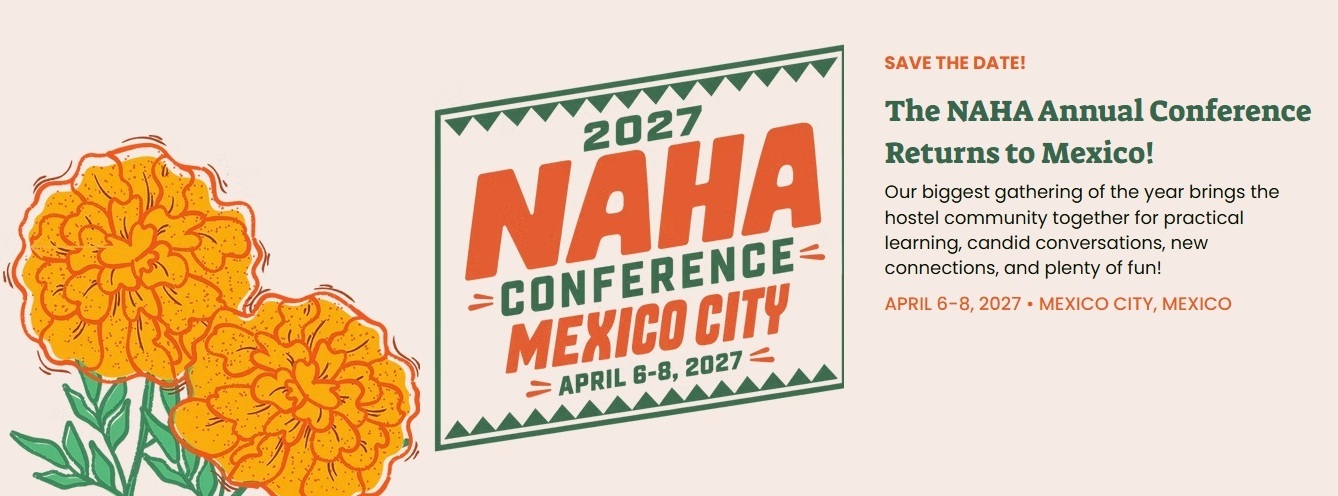
If you want to argue about any of this in person, the NAHA 2027 Annual Conference takes place in Mexico City, April 6 to 8, 2027, which is fitting given the region's growth. It is a good place to test which trends hold up when hostel operators compare real numbers over dinner. Bring your questions, and your skepticism.
Join HostelManagement.com (free): get the Hostel Operator Toolkit, including the OTA listing audit checklist and pricing calendar template, plus the forum where operators test 2027 trends before they become slides.