
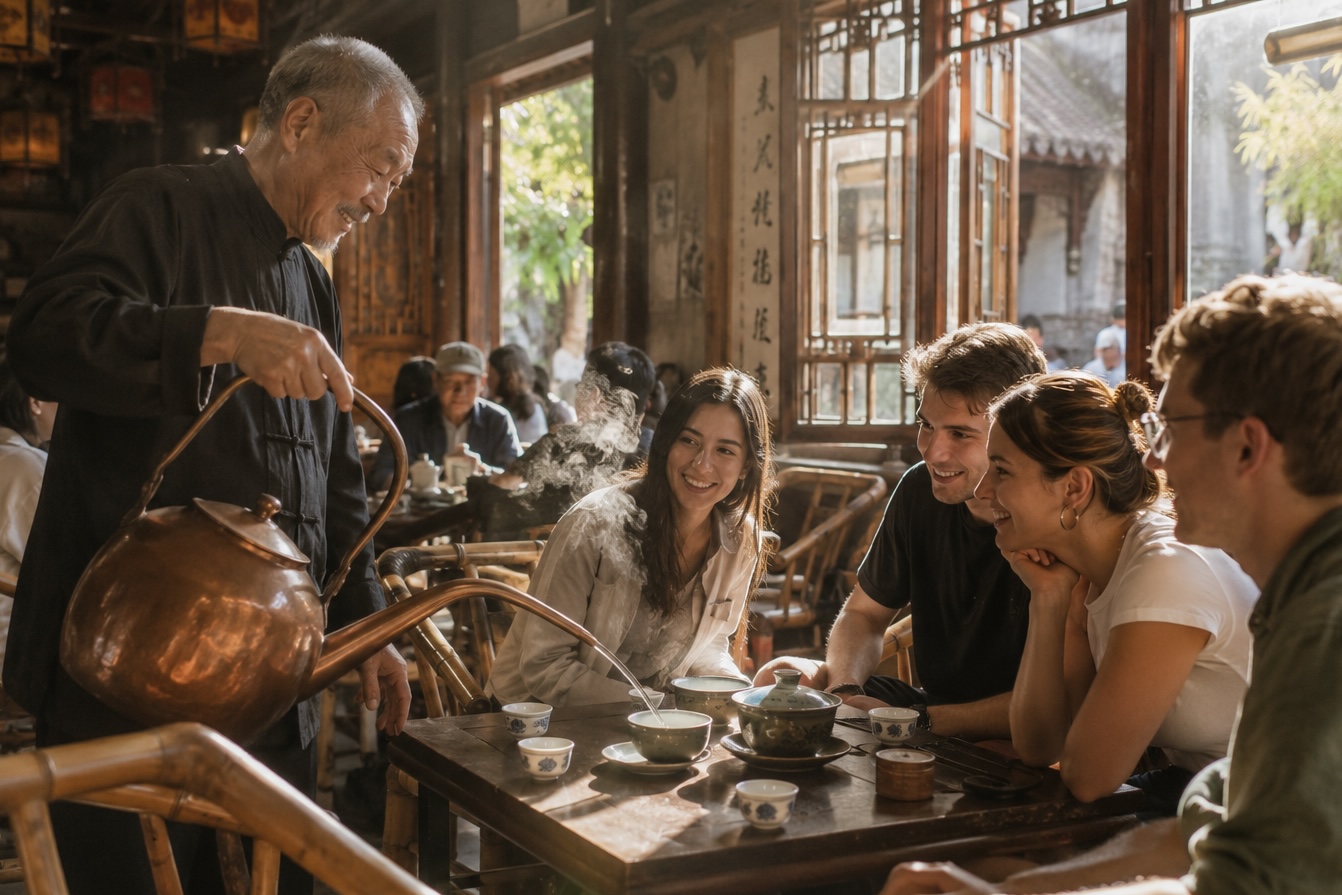
A traveler may choose a destination because of a tea house, a climbing route, a food market or a neighborhood—not because of a famous landmark.
As Chinese travelers increasingly build trips around experiences rather than attractions, accommodation is becoming part of the journey itself.
Not simply a place to sleep.
China's Travel Priorities Are Shifting
Recent reports from Trip.com and Fliggy point to a clear direction in China's domestic travel market.
Interest-based travel, locally led experiences and customised itineraries continue to gain momentum, particularly among younger travelers. Rather than planning trips around famous landmarks alone, many travelers are increasingly organizing their itineraries around specific interests—from tea culture and neighborhood cafés to hiking, cycling, local food and community experiences.
A traveler may choose Chengdu because they want to explore its tea house culture.
They may choose Yangshuo for climbing and outdoor adventures.
They may visit a city because of its food scene, cycling routes or creative communities.
This is more than a change in travel preferences.
It changes the role accommodation plays within the trip itself.
A traveler who chooses a destination for a specific experience is not simply looking for a bed near the main attractions.
Increasingly, they are looking for a place that helps them access the experience they came for.
Accommodation Is Becoming Part of the Experience
When travel revolves primarily around sightseeing, accommodation is often a functional decision.
Convenience, price and location tend to dominate.
As travel becomes more experience-led, these fundamentals remain important—but they are no longer the whole decision.
Where travelers stay can influence who they meet, which neighborhoods they explore and how easily they connect with local culture.
A place to stay can shape the experience of a destination.
For hostel operators, this is a meaningful shift.
Unlike many accommodation formats, hostels have long been built around shared spaces, community interaction and local knowledge.
These characteristics become increasingly valuable when travelers are looking for experiences that extend beyond the destination's major attractions.
A hostel can help a traveler find the neighborhood they would not have discovered alone.
It can introduce them to people they would not otherwise have met.
It can turn a few days in a new city into a more social, local and memorable experience.
This is where the traditional strengths of the hostel model become increasingly relevant to the experience economy.
The Opportunity—and the Challenge—for Hostels
But this opportunity does not automatically belong to every hostel.
The hostel format creates the potential for experience-led travel.
It does not guarantee it.
Two properties may offer similar prices, locations and facilities, yet deliver completely different guest experiences.
One may have an active community, staff who genuinely know the neighborhood and regular opportunities for guests to connect.
Another may have a communal area that is rarely used, staff whose local recommendations rarely go beyond the standard tourist itinerary and no clear reason for guests to interact with one another.
The difference is not necessarily the building.
It is the operation.
As experience becomes a larger part of travel decisions, operational execution matters more.
A hostel's competitive advantage is becoming harder to copy because it depends less on facilities and more on consistently creating experiences that guests remember—and want to share.
Competition Is Moving Beyond Price
Budget accommodation has become increasingly competitive.
Hotels continue to improve their social spaces.
Serviced apartments are targeting longer-stay travelers.
New accommodation formats are competing for many of the same younger and more experience-oriented guests.
In that environment, price remains important.
But increasingly, it is becoming a qualifier rather than a differentiator.
For hostel operators, a more sustainable advantage may lie in something competitors find difficult to replicate quickly:
Genuine local knowledge.
A community that is actively operated, not simply designed into the floor plan.
And a stay that becomes part of the trip itself, rather than simply supporting it.
These are operational capabilities—not marketing messages.
A hostel can say that it has a great atmosphere.
But the real question is whether guests actually experience one.
It can describe itself as connected to the local community.
But the real question is whether a guest can feel that connection during their stay.
As travelers increasingly seek experiences rather than simply places to visit, the difference between what a hostel promises and what it consistently delivers will matter more.
Looking Beyond China
China's travel ecosystem is unique, and its digital landscape differs significantly from many other markets.
Its development should not be treated as a blueprint.
However, one broader shift is becoming increasingly visible across multiple regions: travelers are placing greater value on experiences that extend beyond traditional sightseeing.
China's market is useful not because it predicts the future of every travel market.
It is useful because it offers a clear example of how traveler expectations can evolve.
As more people choose destinations based on what they want to experience—not simply what they want to see—the role of accommodation may continue to change.
A hostel does not have to be the destination.
But it can become the place that helps a traveler experience the destination differently.
For hostel operators, that may be the opportunity hidden inside the experience economy.
The question is no longer only:
"Where will the traveler sleep?"
It is increasingly:
"What kind of experience can begin once they arrive?"
Sources
China Tourism News (CTNews). (2026). Content and AI are reshaping travel search.
TravelDaily. (2026). Healing travel is gaining popularity among Chinese travelers.

