
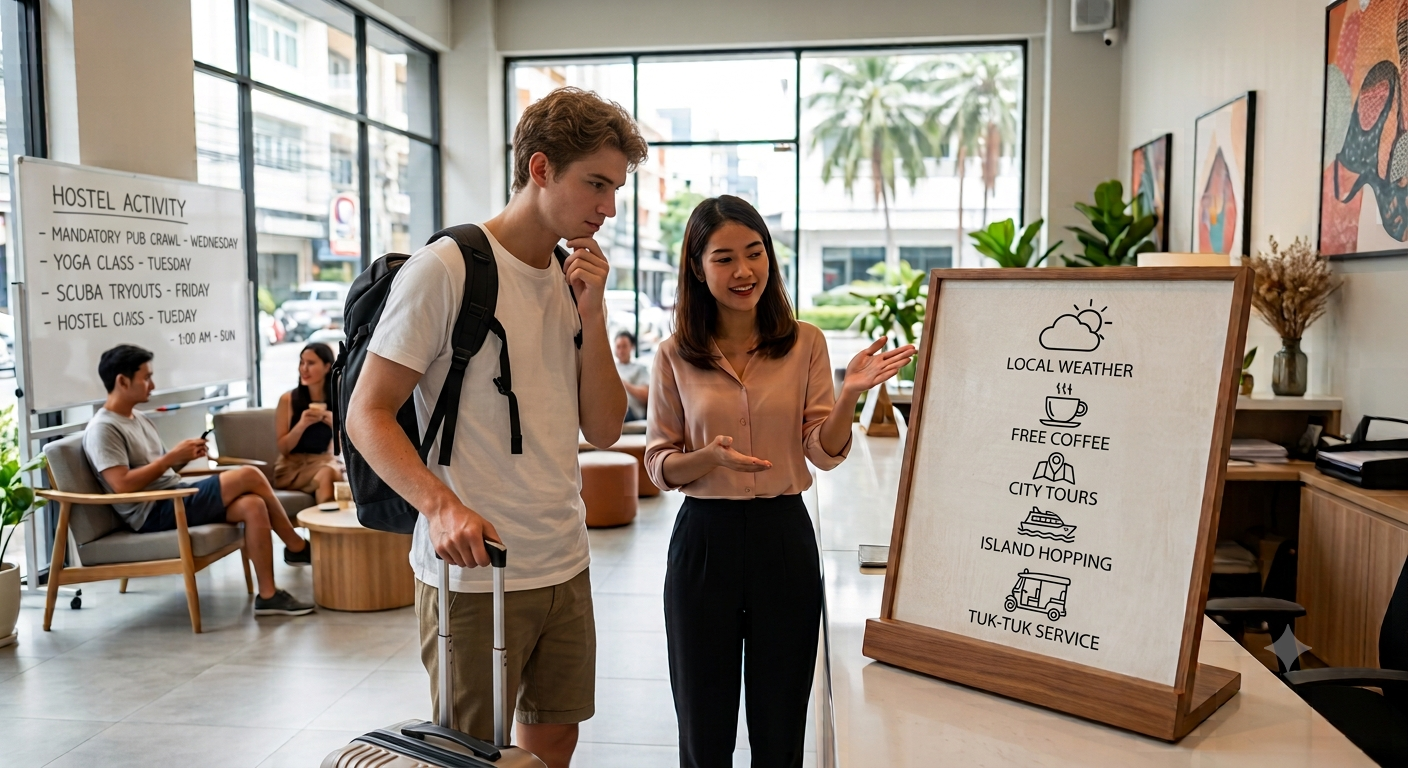
Travelers haven't stopped traveling. They're simply becoming more selective about what they spend once the trip is booked.
A guest may still choose a private room, add breakfast, or book an airport transfer. But when money feels tighter, every extra purchase has to justify itself. “Better” is no longer enough.
For hostels, that matters because some of the most flexible revenue sits outside the room rate: upgrades, late check-outs, breakfast, activities, transfers and other add-ons.
The question is no longer simply whether guests will spend more. It's whether they can immediately understand why something is worth paying for.
A Signal Worth Watching
Deloitte's 2026 Travel Industry Outlook and 2026 Summer Travel Trends Survey point to a more cautious US traveler, with financial concerns influencing travel decisions and discretionary spending even among higher-spending consumers.
The US is not a forecast for Asia. But the underlying behavior is worth watching: travelers may still spend, while becoming more deliberate about what deserves that spend.
For Asian hostels, this is particularly relevant when looking at ancillary revenue. A guest who hesitates over an extra $10 or $20 is not necessarily unwilling to buy. They may simply need a clearer reason.
That makes the first question a practical one: is this happening in your own guest data?
Look at your upsell conversion rate. Check whether cancellations are increasing in particular source markets or room types. See whether booking windows are shortening. If your PMS allows it, segment the results by source market and compare them with inbound tourism data from organizations such as JNTO, TAT or STB.
Macro data can tell you what might be changing. Your own booking data tells you whether it matters to your property.
Stop Selling the Add-On. Sell the Reason.
The instinctive response to a more cautious consumer is often to discount.
I don't think that should be the first move.
Consider the difference between these offers:
“Premium Bed” versus “Guaranteed away from the door and main corridor.”
“Better Linen” versus “A hotel-grade duvet and two pillows after a long-haul flight.”
“Flexible Check-in” versus “Landing at 6am? Shower and be in bed by 8am.”
The underlying product may barely change. What changes is the reason to buy it.
This is especially important for hostels because many of the things they sell are difficult to evaluate before arrival. A guest can't feel the mattress, experience the quiet floor, or know how much planning an activity pass will save them when they're making the booking.
The offer therefore has to do some of that work in advance.
A useful test is simple:
You pay X. You get Y. What problem does it solve?
If the answer isn't obvious, the problem may not be the price.
Sometimes the Product Is Fine. The Message Isn't.
An upsell menu can contain perfectly reasonable products and still perform badly.
A female dorm listed only as a room category says little. If accurate, details such as keycard-controlled access or female staff on the night shift give the guest a much clearer reason to choose it.
An activity pass can be described as “three events.” But for a solo traveler, the real value may be three events, zero planning, and an easier way to meet people.
That distinction matters.
Before adding another promotion, look at what you already sell. Is the product failing to solve a meaningful problem, or is the guest simply not seeing the value?
In my view, rewriting an existing offer is often a better first step than creating another one.
The Reason Has to Arrive at the Right Time
Even a well-written offer can fail if it arrives at the wrong moment.
An upgrade pitched at a busy front desk can feel like a sales tactic. The same offer in a booking confirmation or pre-arrival message gives the guest time to consider it without pressure.
And the promise has to survive the stay.
If you sell a quiet room, the guest should actually experience the difference. If you sell better bedding, they should notice it. If you sell convenience, the process should genuinely remove a small piece of friction.
The transaction isn't finished when the guest pays. It's finished when they feel they got what they paid for.
That is where ancillary revenue becomes more than an extra charge. Done well, it becomes part of the guest experience.
What Asian Hostels Can Take From This
The takeaway isn't that Asian hostels should start cutting prices because US travelers are becoming more cautious.
It's almost the opposite.
Start with your own guest data. Then look at your upsell menu and ask a less comfortable question: if I were the guest, would I immediately understand why this is worth paying for?
If the value is real, make it obvious.
If the product doesn't solve a meaningful problem, rethink it.
And if the product is good but the copy is vague, rewrite the reason.
Your prices don't necessarily need to be lower. The reason to buy needs to be clearer.

