
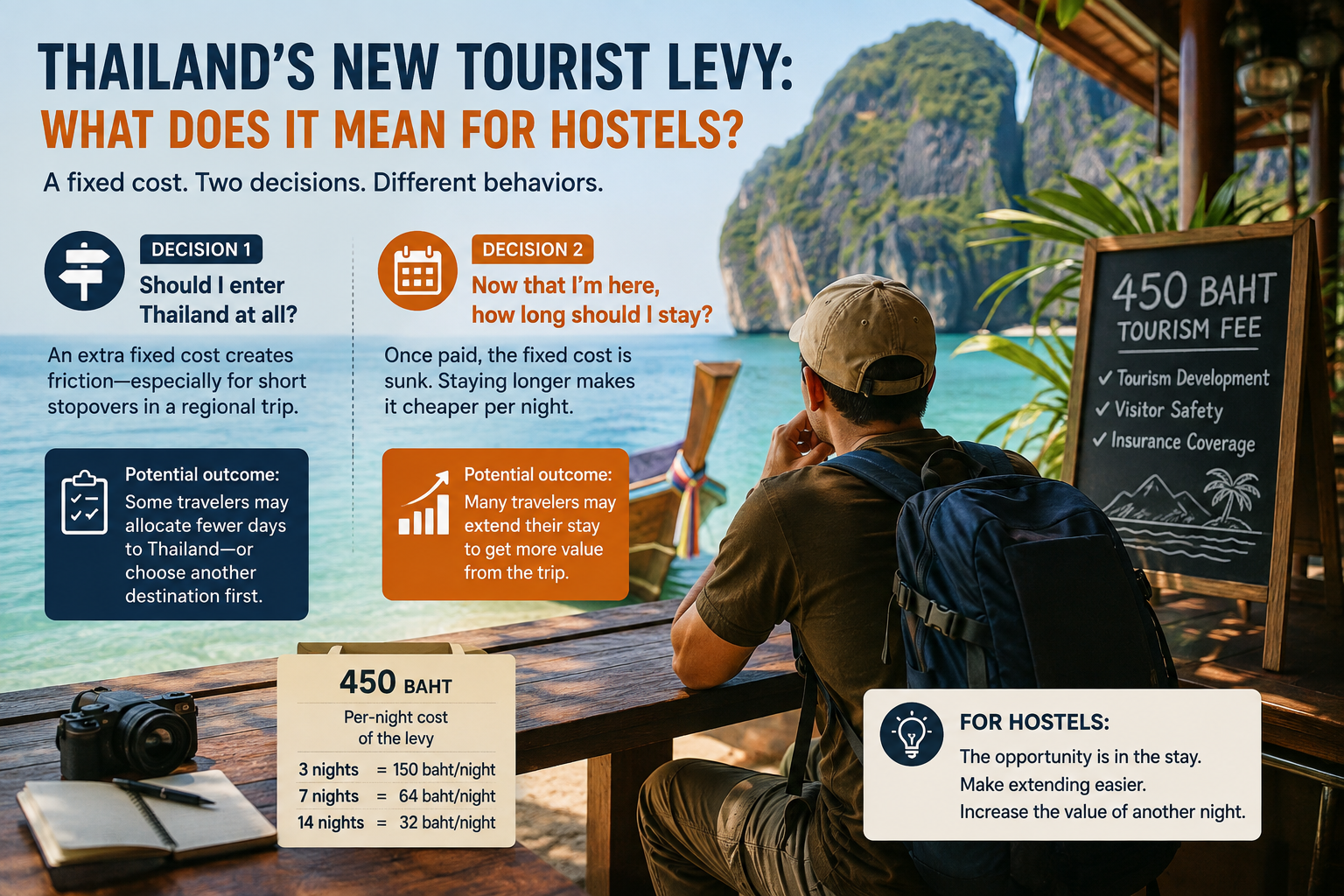
The 450-baht question isn’t whether travelers can afford it. It’s how they will respond to a fixed cost.
The short version: Thailand is proposing a flat 450-baht (~US$13.50) tourism fee for foreign visitors. That is unlikely to stop backpackers from traveling to Thailand altogether. But it could influence how travelers evaluate a Thailand stop — and, interestingly, once they arrive, the same fixed cost could actually give some travelers a reason to stay longer.
For hostel operators, the important question is not simply whether the fee will hurt demand.
It is how travelers will adjust their behavior around it.
The news in 30 seconds
Thailand is proposing a flat 450-baht (~US$13.50) tourism fee for foreign visitors arriving by air, land or sea, replacing the earlier 300-baht air / 150-baht land-and-sea proposal.
The proposal is still under consultation. If approved, implementation is expected to begin with air arrivals, with revenue supporting tourism development, visitor safety and insurance-related measures.
A fixed cost changes the travel equation
Let's start with the obvious question:
Will 450 baht really stop someone from coming to Thailand?
Probably not.
For most international travelers, US$13.50 is a relatively small addition to the cost of a trip.
But travelers don't make decisions based only on whether they can afford something. They also evaluate whether the additional cost feels worth it.
This is where a fixed entry fee becomes interesting.
The 450 baht is paid once, regardless of whether someone stays three nights or three weeks.
That means its effective cost per night falls as the stay gets longer:
3 nights → 150 baht per night
7 nights → about 64 baht per night
14 nights → about 32 baht per night
The longer the stay, the easier the fee is to absorb.
So the behavioral effect is not as simple as:
“Higher entry cost = shorter stay.”
In fact, it can work in the opposite direction.
The two decisions travelers actually make
A traveler considering Thailand is making two separate decisions.
Decision one: Should I enter Thailand at all?
This is where the levy creates friction.
For someone planning a short stop in Bangkok before moving on to another country, an additional fixed cost may make Thailand feel slightly less attractive.
Not because 450 baht is unaffordable.
Because the traveler may think:
“If I'm only staying for two or three nights, is this extra cost worth it?”
That matters in Southeast Asia because travelers often move between destinations rather than choosing one country for an entire trip.
The levy therefore has the potential to influence destination allocation at the margin.
A traveler might still visit Thailand, but start somewhere else, skip one stop, or decide that a very short Thailand visit isn't worth the additional friction.
For hostels, this is the part of the policy worth watching.
Decision two: Now that I'm here, how long should I stay?
Here the equation changes.
Once the traveler has already paid the 450 baht, leaving after two nights does not make the fee disappear.
Staying another three or four nights, however, makes the fixed cost cheaper on a per-night basis.
This creates a simple psychological and economic argument:
“I've already paid to enter. I might as well make the most of it.”
That does not mean the levy will automatically increase length of stay.
But it means hostel operators should not assume the policy will mechanically push stays shorter.
There is a potential amortization effect working in the opposite direction.
And that is where the opportunity begins.
For hostels, the opportunity is in the stay — not the fee
The levy itself is outside a hostel's control.
What operators can control is what happens after the guest decides to come.
If a guest is already in Thailand, the goal should be to make extending the stay easy and worthwhile.
That means looking beyond nightly pricing:
Weekly and longer-stay rates
Flexible extensions
Work-friendly facilities
Social programming
Local experiences
Laundry and other practical long-stay services
Convenient transport and activity arrangements
The objective is not simply to offer a cheaper bed.
It is to increase the value of another night.
That is a more sustainable response than trying to compete on price alone.
Don't watch arrivals alone. Watch the behavior underneath.
This is where hostel operators have an advantage over national tourism statistics.
A country can report healthy visitor arrivals while individual hostels experience meaningful changes in guest behavior.
If the levy eventually takes effect, I would monitor five things particularly closely:
1. Average length of stay
Does it move up, down or remain unchanged?
2. Short-stay share
Are two- and three-night bookings becoming more or less common?
3. Booking patterns
Are travelers booking Thailand as a longer base or as a short stop within a regional itinerary?
4. Revenue per guest
If length of stay increases, are guests also spending more on activities, food, coworking or other ancillary services?
5. Source-market differences
Price sensitivity will not be identical across nationalities, traveler profiles or trip types.
The key is to establish a baseline before the fee is implemented.
Otherwise, when something changes, you won't know whether the levy caused it.
The bigger signal: Thailand wants more value, not simply more visitors
The 450-baht proposal should also be viewed within Thailand's broader tourism strategy.
The government has increasingly emphasized higher-value tourism, sustainability, safety and encouraging travelers to extend their stays and spend more. Its 2027 tourism strategy explicitly frames the shift as moving from measuring success primarily through tourist volume toward quality, economic value and sustainability.
That does not mean Thailand is turning its back on budget travelers.
But it does mean hostel operators should pay attention to where the market is heading.
A business model built entirely around:
cheap bed → short stay → high occupancy
may become less resilient than one built around:
longer stay → stronger experience → higher revenue per guest.
The levy does not create that shift by itself.
It simply makes the direction more visible.
What should hostel operators do now?
1. Don't panic — establish your baseline
The fee is not yet being collected.
Use this period to understand your current guest mix, average length of stay, booking window and revenue per guest.
You need a baseline before you can measure an impact.
2. Build a stronger long-stay proposition
Don't wait for the levy to become a problem.
Look at what would make a guest naturally extend from three nights to seven.
That might be pricing, but it could just as easily be convenience, community, work facilities or better access to local experiences.
3. Think beyond the bed
If the strategic objective is to increase revenue per guest, occupancy is only part of the equation.
A guest who stays seven nights and spends on activities, laundry, food, coworking or tours can be significantly more valuable than a guest who stays three nights and buys nothing else.
The levy makes this total guest value more relevant.
4. Communicate the fee clearly when the policy is finalized
There is already a history of Thailand discussing tourism fees without immediate implementation. The current proposal should therefore be communicated carefully.
Don't create unnecessary anxiety before the policy is final.
But once the details are confirmed, make the information simple:
What is it? Who pays? When is it collected? What does it fund?
Clear communication can remove friction at the booking and arrival stages.
My take
The question for hostel operators isn't whether 450 baht is expensive enough to stop travelers from coming.
It's whether a fixed entry cost changes where travelers choose to go, how long they stay, and how much value they generate once they arrive.
That creates a potential risk at the destination-selection stage — but also an opportunity to make longer stays and higher guest spend more attractive.
Don't build your strategy around the 450 baht. Build it around the guest behavior it may change.
Track it. Test it. And let your own booking data tell you what happens next.
Source
Thailand Proposes New THB450 (~US$13.50) Tourism Fee for All Foreign Visitors

