

The short version: Nobody outside Hostelworld knows the exact ranking formula, and anyone who says otherwise is selling something. What you can do is observe the factors that consistently move position, and test them one at a time.
A note on secret formulas
Every few months, someone in a hostel group chat announces that they have cracked the Hostelworld algorithm. The method usually involves a cousin who knows someone, and the result usually involves a two-week bump that nobody can reproduce.
This column makes no such claim. It is based on what Hostelworld has said publicly about how listings are ordered, what operators commonly observe, and the logic of how any marketplace ranks inventory. As of this writing, Hostelworld's own Elevate help page says its sort order blends quality signals (guest reviews, location, traveller behaviour, historical performance, live pricing, device and platform performance, and a Net Competitiveness Score) with economic signals (average bed price, historical production and commission level). It does not publish the weights. The specifics will change. The logic behind them changes much more slowly.
That logic is simple. Hostelworld earns money when a guest books and stays without complaint. Its ranking therefore tends to reward listings that get clicked, get booked, get good reviews and do not cause trouble. Everything below is a version of that sentence.
The factors you can observe
1. Reviews and rating
The rating is the most visible signal on the platform, and guest reviews are the first quality signal Hostelworld lists on its Elevate page as of this writing. How heavily they count is not published. Two features matter beyond the headline score: recency, because a 9.1 built on reviews from three years ago tells a guest less than an 8.8 from last month, and volume, because a score built on twenty reviews is more fragile than one built on two thousand.
What to watch: your rating trend over the last 90 days, the number of new reviews per month, and the specific sub-scores (cleanliness, staff, location, atmosphere and so on) dragging the average down. As of this writing, Hostelworld's HOSCARs help page lists seven categories: cleanliness, staff, atmosphere, facilities, value for money, safety and location. One weak sub-score fixed is usually worth more than five strong ones polished.
2. Conversion
A listing that is shown often but rarely booked is, from a marketplace's point of view, a listing wasting space. Conversion (views to bookings) is a widely assumed ranking input on most OTAs, and it is the factor most directly under your control. Booking.com, for one, says on its How we work page that click-through rate and bookings drive its default order; Hostelworld lists "traveller behaviour" and "historical performance" among its signals without defining them. As of this writing, Hostelworld's Booking Reports & Stats help page lists booking, customer nationality and rating reports rather than views or conversion, so you may need to estimate conversion yourself.
Conversion is driven by the things a guest sees in the first few seconds: the lead photo, the price relative to neighbours, the rating, and whatever badges or labels appear on the listing card. Then, on the property page, by the honesty and clarity of the description and the presence of the facts guests look for (lockers, curtains, bathrooms per bed, kitchen, female-only options).
3. Availability
You cannot rank for dates you are not selling. Hostels that close out Hostelworld inventory during busy periods to push direct bookings sometimes find their position slower to recover afterwards. That is operator observation, not something Hostelworld publishes, though "historical production" does appear among its economic signals. Whether that is an explicit penalty or simply the effect of lost bookings and reviews feeding back into ranking is hard to tell from outside, and for practical purposes it does not matter. Consistent availability across dates and room types appears to help; gaps appear to hurt.
4. Rate competitiveness and parity
Price is shown prominently and is an obvious driver of clicks and bookings. Hostelworld also notices when the same bed is cheaper elsewhere: as of this writing, its Elevate page says its Net Competitiveness Score compares your price and availability with other channels, and that Elevate "works best when paired with competitive pricing". Rules on parity clauses vary by country and contract, so check yours. Practically, the fastest way to lose both conversion and goodwill is an accidental disparity: a stale rate, a promotion that never switched off, a currency rounding glitch.
5. Content and photos
Listings with complete, current content tend to convert better, and conversion feeds ranking. Look for gaps: missing room types, missing amenities, photos that predate your renovation, or a lead image that shows a building exterior when guests want to see the beds. A good set of photos shows the dorm from bed height, the bathrooms, the common areas with people in them (with permission), and the street outside.
6. Responsiveness
Guests message before they book and after. Hostelworld does not publish whether response speed feeds its ranking, but as of this writing its HOSCARs help page lists "respond quickly and helpfully to guest messages" as a tip for better ratings, and ratings do feed the sort order. At minimum, slow replies cost you the booking in front of you.
7. Cancellation policy
Flexible cancellation increases conversion; it also increases cancellations. As of this writing, Hostelworld's rate types guide runs from Free Cancellation and Standard Flexible Booking (a deposit plus a Cancellation Protection fee, with timely cancellations refunded as a voucher) through to Non-Refundable and Non-Refundable Pay Now. It does not say any of them earns extra visibility, so treat claims that one does as unproven. The trade-off is real and specific to your hostel: run it through your own numbers rather than assuming flexibility always wins.
8. Promotions and programmes
Hostelworld's current paid visibility tool is Elevate. As of this writing, its Elevate help page says the tool lets you raise your commission level to push your property higher in the sort order, offers a simulator that estimates position and click share before you activate, and is used by more than 3,000 hostels. Paying for position can work, particularly in low season, but measure it like any other marketing spend: what did the extra commission buy in additional bookings, net of what you would have sold anyway?
Social features
Hostelworld has leaned into social features in recent years, and as of this writing its social features page lists Hostel and City Chats (open from 7 days before check-in and during the stay), Traveller Profiles you can see once you have booked, and Linkups, activities organised by hostels and travellers, all in the app. Whether participation affects ranking is not something operators can confirm, but anything that increases bookings and positive reviews feeds the factors above. Treat it as a conversion tool first.
What probably does not matter as much as people think
- Changing your description weekly. Freshness of content is a reasonable idea; churning text for its own sake is not.
- Tiny price changes to "trigger" the algorithm. Rate moves that are not driven by demand mostly confuse guests.
- Keyword stuffing. Guests read listings. Guests who read nonsense do not book.
A practical 30-day test plan
The only reliable way to learn what moves your listing is to change one thing at a time and watch what happens. Here is a four-week plan that fits around normal operations.
Before you start: baseline (days 1 to 3)
- Choose three fixed searches that represent your main demand: for example, your city for two adults in a dorm on a Friday six weeks out, a weekday two weeks out, and a weekend next month. Use the same device, logged out, at the same time of day. Record your position for each.
- Pull your extranet numbers for the last 30 days: bookings, lead time, average rate, rating and review count, plus views and conversion if any dashboard you use shows them. As of this writing, Hostelworld's Booking Reports & Stats page lists Booking Analysis, Customer Analysis and Customer Rating reports.
- Screenshot your listing card and property page as they stand.
- Log everything in one sheet, dated.
Position will wobble day to day. You are looking for sustained shifts, not daily noise.
Week 1: content (days 4 to 10)
Change only content.
- Replace the lead photo with your best image of the beds or common area.
- Fill every missing amenity, room description and policy field.
- Rewrite the first two lines of the description to state the three things guests most often praise in reviews.
Record position on your three searches every other day, and note bookings (and views, if you can see them) at the end of the week.
Week 2: availability and rates (days 11 to 17)
Leave content alone. Now:
- Open all room types across the next 90 days, removing any manual close-outs that are not strictly necessary.
- Audit rates across every channel for parity errors and fix them.
- Check minimum-stay and closed-to-arrival restrictions for stale settings.
Record the same metrics.
Week 3: responsiveness and reviews (days 18 to 24)
- Answer every guest message within a target time (set one; an hour during staffed hours is a reasonable start).
- Reply to every new review, briefly and specifically, including the critical ones.
- Introduce a polite review prompt at checkout, in person or by message. Do not offer incentives for reviews: as of this writing, Hostelworld's review guidelines say it does not allow reviews where owners or managers use incentives or threats to influence customers.
- Fix the single most complained-about issue from your last 50 reviews, and mention the fix in your replies.
Week 4: one policy or programme test (days 25 to 30)
Pick one:
- Add or adjust a flexible cancellation rate plan, or
- Trial a paid visibility option or promotion, if available and if the numbers make sense.
Do not do both. Record the same metrics.
Day 30: read the results
Compare each week against your baseline:
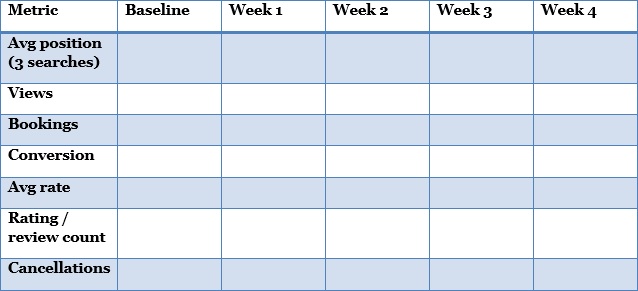
Some changes act slowly. Review improvements in particular can take longer than a week to show in ranking. But this sheet will tell you more about your listing than any number of confident rumours, and a second 30-day cycle will tell you more again.
Be honest about confounders. A festival in week 2 will inflate everything. A competitor closing for refurbishment will flatter your position. Note anything unusual in the sheet as it happens.
The unglamorous conclusion
If there is a secret to Hostelworld's ranking, it is that it is not much of a secret. Be bookable on the dates guests want. Look like what you are. Price consistently. Answer quickly. Earn good reviews and keep earning them. Then measure what each change does, because your hostel, in your city, against your competitors, is the only case that matters.
Related: https://hostelmanagement.com/ota-listing-alert-service
Related: forum board "OTAs and Distribution"
Related: Hostel Operator Toolkit "OTA listing audit checklist"

