
The short version: A hostel is a property business wearing a hospitality costume, and most failures start with the property, not the vibe. Prove demand, lock the right building and the right permits, then fund twelve months of operating losses before you buy a single bunk.
Every year a fresh cohort of travellers returns from six months on the road convinced that the hostel they loved in Lisbon could be reproduced, with improvements, in their hometown. Some of them are right. Most of them have confused a good stay with a good business, which is a bit like deciding to open a restaurant because you enjoyed dinner.
This guide is for the ones who want to do it properly: the sequence that separates hostels that open on time and on budget from those that open late, over budget, and with a fire inspector's number saved under "Do Not Answer". Costs, rules and financing vary enormously by country and city, so treat the numbers here as a framework for your homework, not a substitute for it.
Step 1: The concept and the market check
Decide who you are for
"Backpackers" is not a market. It is a word that covers gap-year teenagers, digital nomads with standing desks, budget-conscious families, touring musicians, school groups and the 58-year-old cyclist who has been doing this since before you were born. Each of these guests wants different things from a bed, a kitchen and a common room, and each pays a different rate on a different booking window.
Pick a primary guest and a secondary one. A party hostel and a quiet, design-led "poshtel" can both be excellent businesses, but they cannot be the same building on the same night. Your concept dictates your room mix (how many dorms versus privates), your staffing, your noise policy, your food and beverage plan and, crucially, your planning application.
Test demand before you fall in love
Before you look at a single property, answer three questions with evidence:
1. Is there visible demand? Look at the existing hostels in your target area on the major OTAs across a full year of dates, not just next weekend. Note how often they show limited availability, what they charge for a dorm bed on a Tuesday in February versus a Saturday in July, and how their review counts grow over time (a rough proxy for volume).
2. What drives visitors here? Universities, festivals, transit hubs, hiking routes, a cruise terminal, a conference centre. Demand anchored to something permanent beats demand anchored to a trend.
3. Where is the gap? If six hostels already compete on price within ten minutes' walk of the station, the gap is not "a seventh hostel, slightly cheaper". It might be more privates, a better location for a particular audience, or simply a building that does not smell of damp.
Tourism boards and national statistics offices usually publish visitor arrival and accommodation occupancy data; it is often free and frequently ignored, though coverage varies by country. In Europe, for example, Eurostat's tourism section publishes data on the capacity and occupancy of tourist accommodation establishments, including nights spent, as of this writing. Read it anyway. A lender certainly will.
Step 2: Location, location, licensing
Hostel location is a three-way negotiation between guests, neighbours and the planning department.
Guests want walkability to the things they came for and to public transport. Twenty minutes from the old town on foot is acceptable; twenty minutes on a bus that stops at 10pm is a review problem.
Neighbours want you not to exist, or at least not to exist loudly. A building sharing walls with residential flats will cost you in soundproofing, complaints and, possibly, your licence.
Planners want the building's permitted use to match what you intend to do in it. This is the point where many projects quietly die. A building zoned for offices, retail or residential may not legally operate as short-stay accommodation without a change of use, and in some cities short-term lodging is restricted or capped by district. In England, for instance, the Planning Portal's use classes guide lists hostels as "sui generis", outside the hotel class (C1), and says a change of use may need planning permission or prior approval, as of this writing. Your own city's planning office is the only answer that counts.
The practical rule: do not sign a lease or a purchase contract until you have confirmed, in writing where possible, that hostel use is permitted or achievable at that address. Make any offer conditional on planning where the market allows. A cheap building with the wrong zoning is not cheap; it is a very expensive storage unit.
Step 3: Build, convert, or buy
There are three routes into a hostel, and they suit different people.
Build from scratch
Maximum control, maximum risk, maximum time. You design the room mix, bathrooms and fire strategy from day one. You also take on land, full planning, construction risk and a timeline that can stretch past two years. Rarely the right first project without development experience or a partner who has it.
Convert an existing building
The most common route for independent operators. Former hotels, guesthouses, offices, warehouses and large townhouses are the usual candidates. Conversion is faster than building but full of surprises: plumbing that will not support the bathroom count you need, floors that need reinforcing for bunk density, and fire escape routes that do not exist yet. Budget a contingency (see below) and get a building surveyor and a fire engineer through the door before you commit. Buy an operating hostel You inherit revenue, reviews, OTA rankings, staff and, ideally, licences. You also inherit someone else's decisions and possibly their problems. Buying a going concern is often the lowest-risk route to cash flow, provided you value it properly and do serious due diligence on the seller's numbers (we have a separate column on exactly that).
A fourth variant deserves mention: leasing a building, either as a shell you fit out or as an existing hostel business you take over. Leasing lowers the upfront capital dramatically, but the lease terms (length, rent reviews, break clauses, who pays for structural repairs) become the single most important document in your business. A great hostel on a three-year lease is a great hostel for three years.
Step 4: What it costs
Here is where honesty matters most, because the internet is full of "open a hostel for $50,000" stories that omit the building, the permits, the founders' unpaid salaries and the year of thin trading.
There is no universal cost of opening a hostel. A 20-bed conversion in a low-cost market and a 200-bed new build in a capital city are different species. What follows is a structure, with illustrative figures to show proportion, not a quote.
Capital expenditure (capex)
The typical buckets:
Property: purchase price or lease premium and deposit. Often the largest single item by a distance.
Building works: structural work, bathrooms, electrics, plumbing, HVAC, soundproofing.
Fire and life safety: alarm and detection systems, emergency lighting, fire doors, sprinklers where required, signage. Non-negotiable and frequently underestimated.
Fit-out and FF&E (furniture, fixtures and equipment): bunks, mattresses, lockers, linen, kitchen, common-room furniture, reception.
Technology: PMS, channel manager, door locks or key-card system, Wi-Fi infrastructure, CCTV where lawful.
Professional fees: architect, surveyor, fire engineer, lawyer, accountant, planning consultant.
Pre-opening costs: staff hired before opening, marketing, photography, soft-opening losses.
Contingency: a meaningful percentage of works costs for a conversion, and more for older buildings. Size it with your surveyor or quantity surveyor once they have seen the building, not from a rule of thumb.
Illustrative example (a 40-bed conversion on a lease, mid-cost city):
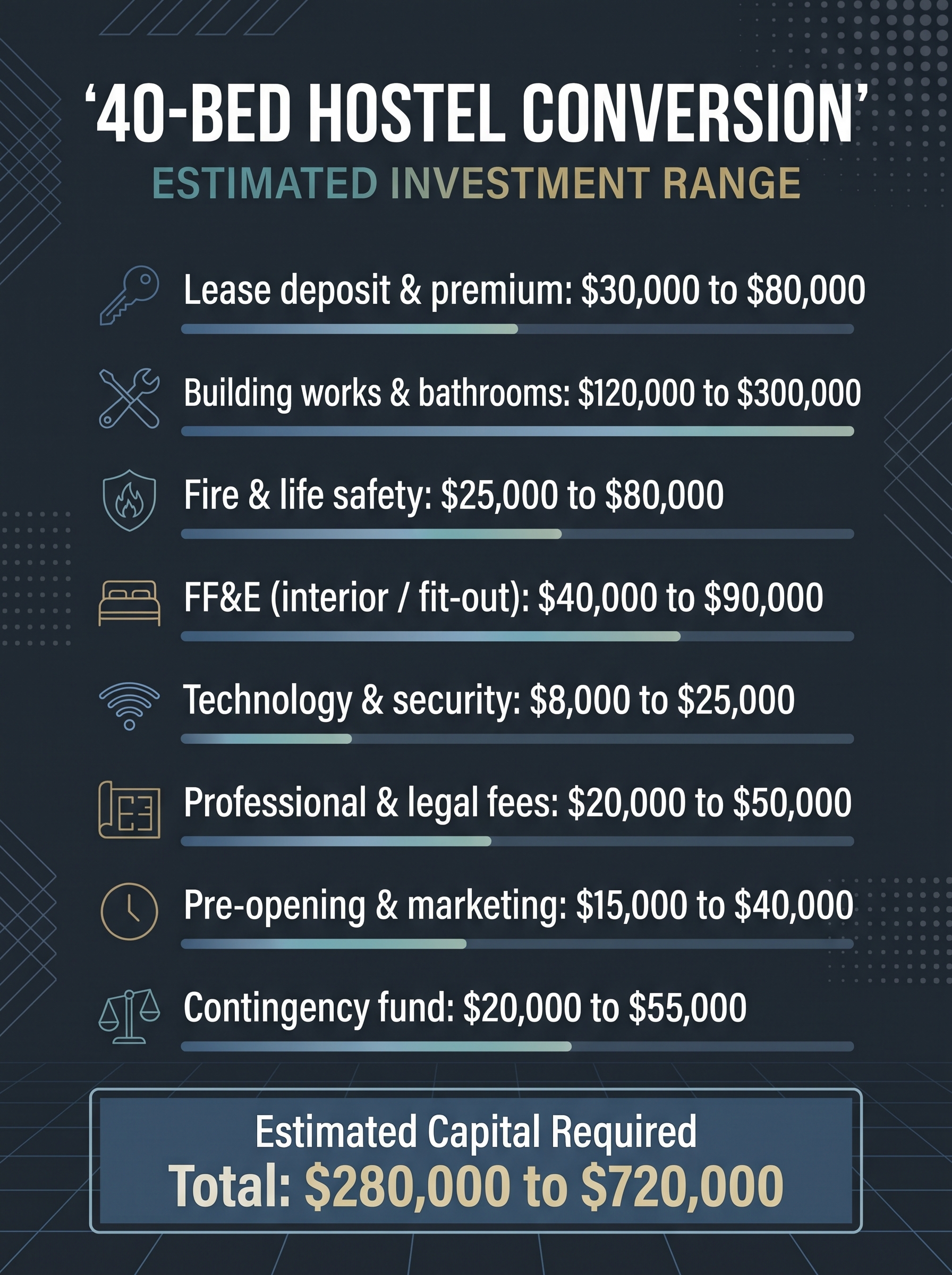
These figures are illustrative only, chosen to show the shape of a budget rather than predict yours; replace every line with local quotes before you put a number in any plan. Notice that the property side and the building works dwarf the fun items. Notice too that the range is wide; that width is the honest part.
Operating expenditure (opex)
Once open, the recurring costs are broadly: Staff: usually the largest operating cost. Reception cover 24/7 (or a credible self check-in model), housekeeping, maintenance, management.Rent or mortgage payments. Utilities: hostels use a lot of hot water, laundry and electricity per guest. OTA commissions: a meaningful percentage of each booking taken through third-party platforms. As of this writing, Booking.com's partner guidance says its commission rate depends on your location and property type, and Hostelworld Group's 2025 results report an effective commission rate of 16.2% for 2025. Your own contract sets your actual rate.Linen, laundry and consumables.Insurance, licences and renewals. Software subscriptions (best of best 2026). Repairs and maintenance: dorms are hard on furniture. Budget for replacement, not just repair. Marketing.
Working capital: the line people leave out
Fund at least six, and preferably twelve, months of operating costs before you open, on the assumption that occupancy will ramp slowly while your reviews accumulate. A new listing with zero reviews competes poorly against a neighbour with four thousand. The hostels that survive year one are rarely the ones with the best murals; they are the ones that did not run out of cash in month five.
Step 5: Licensing, zoning and fire code
This section is general information only. Licensing, planning, fire and tax rules differ widely between countries, regions and cities. Engage a local lawyer, planning consultant and fire safety professional before you commit money.
With that said, most jurisdictions will want to see some version of the following:
Planning and zoning
Confirmation that short-stay accommodation is a permitted use at the property, or a successful change-of-use application. Some cities also cap tourist accommodation in certain neighbourhoods or require specific short-term rental registrations. New York City, for example, requires short-term rental hosts to register and bars platforms from processing bookings for unregistered rentals, according to the Mayor's Office of Special Enforcement as of this writing. In the EU, the European Commission says new short-term rental rules applying from May 2026 give registered units a unique registration number that platforms must display and check, in member states that use the system.
Business and accommodation licensing
Many places require a specific lodging, hotel or hostel licence, sometimes with a registration number that must appear on your OTA listings. Some require guest registration with police or immigration authorities, particularly for foreign nationals. Spain is a clear example: as of this writing, Real Decreto 933/2021 requires accommodation businesses to keep an electronic guest register and send guest data to the Interior Ministry's security systems within 24 hours of a booking or check-in.
Fire safety
This is where hostels are held to a higher standard than you might expect, and rightly so: you have many unrelated people sleeping in a building they do not know, some of whom arrived at 2am after a pub crawl. Expect requirements around:
Fire risk assessment by a competent person.
Detection and alarm systems appropriate to sleeping accommodation.
Protected escape routes, fire doors and emergency lighting.
Occupancy limits per room, often tied to floor area and exit capacity.
Sprinklers, depending on building height, size and local code. As one US benchmark, the U.S. Fire Administration says, as of this writing, that properties on its Hotel-Motel National Master List need an automatic sprinkler system in each guest room if the building is four or more stories tall. Your local fire authority sets the rule that applies to you.
Staff fire training and documented evacuation procedures.
Bring the fire authority or a fire engineer in early. Designing to the fire strategy is cheap. Retrofitting after a failed inspection is not.
Everything else
Food hygiene registration if you serve food, an alcohol licence if you run a bar, music licensing if you play recorded music in public areas, accessibility obligations, data protection rules for guest information, and tourist or occupancy tax collection. These taxes are spreading: as of this writing, City of Edinburgh Council says its visitor levy of 5% of the accommodation cost, on the first five nights, applies to hostels for stays from 24 July 2026. Check what your city charges. None of these is difficult on its own. Together they form a project plan, so put them on a list with owners and dates.
Step 6: Financing the thing
Hostels can be awkward to finance. Banks like property and dislike young hospitality businesses; you are asking them to like a young hospitality business in a property. The routes worth exploring:
Government-backed small business loans
In the United States, SBA-guaranteed loans (such as the 7(a) and 504 programs) are a common route for owner-operators buying or developing hospitality property, because the government guarantee reduces the lender's risk. As of this writing, the SBA says 7(a) loans go up to $5 million and can be used to acquire, refinance or improve real estate, while 504 loans offer long-term, fixed-rate financing for major fixed assets such as buildings and land. Both require an operating, for-profit US business that meets SBA size standards. Down payment and equity requirements are set deal by deal, so ask the lender or Certified Development Company early. Many other countries run comparable guarantee or small-business lending schemes. Expect to need a detailed business plan, personal investment, personal guarantees and, ideally, hospitality experience on the team.
Conventional commercial mortgages
Viable if you are buying the building and have meaningful equity. Lenders will look at loan-to-value, your track record and the property's alternative use value (that is, what they could sell it as if your hostel fails). A building that could easily become flats is easier to finance than a purpose-built oddity.
Private investors
Friends, family, angels, or local investors who like hospitality. Clarify early whether they are lending (and expect repayment with interest) or investing (and expect equity and a say). Put it in writing with a lawyer, even if the investor is your uncle. Especially if the investor is your uncle.
Operating partners
If you have the concept and the energy but not the capital, a partnership with a property owner can work: they provide the building, you provide the operation, and you share the upside through a lease, a management agreement or a joint venture. Read the terms of any such deal at least twice and have a professional read them once more.
Leasing as financing
Leasing an existing building is, functionally, a way of financing the property through rent rather than debt. It frees capital for fit-out and working capital. The trade-off is that you are building value in someone else's asset, so negotiate the longest secure term you can, with renewal rights.
Whatever the mix, lenders and investors want the same three things: a credible market case, a realistic financial model with a downside scenario, and evidence that the people running it know what they are doing. If you have never worked in a hostel, consider working in one. It is the cheapest MBA available, and it comes with free breakfast.
Step 7: The tech stack
You need less technology than vendors will suggest and more than you think on opening day.
Property management system (PMS)
Your operational core: reservations, bed allocation, check-in, payments, guest records, reporting. Choose one designed for hostels specifically, because bed-level inventory (selling individual beds in a dorm, not just rooms) is a requirement many hotel systems handle poorly. Ask about dorm gender settings, group bookings, deposits and how it handles split stays.
Channel manager Pushes your availability and rates to the OTAs and pulls bookings back, so you do not sell the same bed twice. Many hostel PMS products include one or integrate tightly with one. Test the sync with a dummy booking before opening; overbooking on night one is an unwelcome tradition.
Booking engine; A direct booking widget on your own website. Every direct booking saves you commission, so make the direct route easy and give guests a reason to use it.
The supporting cast
Payments: card terminals and online payment processing integrated with the PMS.
Locks: key cards or code locks tied to bookings reduce lost keys and late-night lockouts.
Wi-Fi: enterprise-grade, properly designed for density. Guests forgive a small locker. They do not forgive bad Wi-Fi.
Revenue management: a pricing calendar at minimum; dynamic pricing tools once you have data.
Guest messaging and reviews: pre-arrival messages, post-stay review requests.
Accounting: connected to the PMS so your nightly figures do not live in a spreadsheet named "FINAL_v7".
Step 8: The pre-opening timeline
An illustrative timeline for a conversion, assuming a building is found and planning is achievable. Your mileage will vary, mostly upwards.
12 to 18 months out: concept, market research, business plan, financing conversations, property search.
9 to 12 months out: property secured (conditional on planning where possible), surveys, architect and fire engineer appointed, planning or change-of-use application submitted.
6 to 9 months out: permits granted, contractors tendered and appointed, works begin. Brand, website and photography brief started.
3 to 6 months out: works continue. PMS, channel manager and locks selected and configured. Licence applications submitted. Recruitment of a manager.
1 to 3 months out: works complete, fire and safety inspections, FF&E installed, OTA listings built (open bookings as soon as you have a confident opening date), staff hired and trained, SOPs written.
Final month: snagging, soft opening with friends, local hosts and a few forgiving guests, then opening.
Step 9: The common mistakes
The same errors appear with depressing regularity:
1. Signing before planning. Committing to a building before confirming hostel use is permitted.
2. Underfunding working capital. Spending everything on the build and opening with no runway.
3. Underestimating fire safety. Treating it as a final inspection rather than a design input.
4. Ignoring the neighbours. Noise complaints can become licence problems.
5. Designing for Instagram, not operations. A beautiful reception desk nobody can see from the front door; a laundry room on the fourth floor with no lift.
6. Too few bathrooms. The queue for the shower at 8am is where your review score is decided.
7. Over-reliance on OTAs. They are essential for discovery, but a hostel with no direct channel is renting its own guests back at commission.
8. No SOPs. Running everything from the founder's head works until the founder wants a day off.
9. Hiring friends without a contract. It is fun until it is not.
10. Assuming it will be full. Model your first year at modest occupancy and be pleasantly surprised, rather than the other way round.
Final word
Opening a hostel is achievable, and the good ones are among the most enjoyable businesses in hospitality. But the romance is the reward, not the plan. Do the market work, secure the right building with the right permissions, design around fire safety, fund your first year honestly, and build systems before you need them. The guests who arrive at 2am with a dead phone and no booking confirmation will still be there. You will simply be ready for them.
Join HostelManagement.com (free): get the Hostel Operator Toolkit (SOP checklist, staff onboarding template, OTA listing audit checklist, pricing calendar template) and ask your opening questions in the forum, where people who have already made these mistakes will happily tell you about them.

