
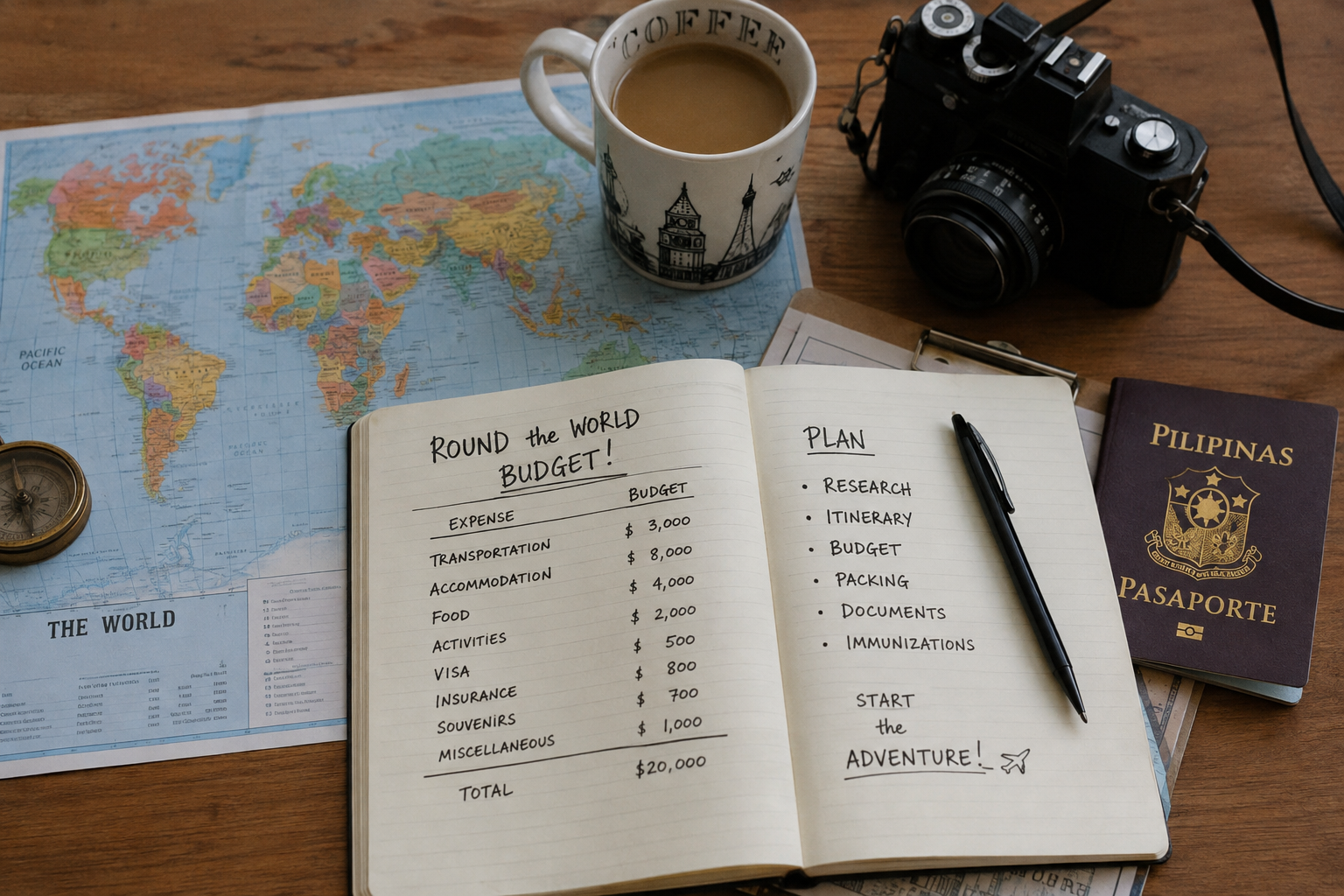
The Ultimate Guide to Budgeting for a Round-the-World Trip
There is a moment that arrives in the life of nearly every aspiring nomad. It often begins with a map pinned to a wall, a spreadsheet opened late at night, or a growing suspicion that the world is far larger than the routine of daily life. The dream of traveling across continents can feel intoxicating, but it also raises the question that stops many journeys before they begin: how much does a round-the-world trip actually cost?
As a financial planner who has spent years analyzing travel budgets and long-term savings strategies, I have found that most people approach global travel backward. They start with destinations and flights, then attempt to force their finances to fit the dream. Successful travelers do the opposite. They begin with mathematics.
The first principle of building a realistic round-the-world trip budget is understanding that the journey consists of two separate financial systems. The first is transportation, primarily international flights. The second is daily living expenses, including accommodation, food, local transportation, activities, insurance, visas, and emergency reserves. Industry estimates for round-the-world airfare vary widely, but economy-class itineraries commonly range from approximately three thousand to ten thousand United States dollars depending on routing, seasonality, and the number of stops. More customized multi-stop routes can begin around two thousand five hundred dollars and rise substantially for complex itineraries.
To calculate a realistic budget, begin with duration rather than destinations. Consider a traveler planning a twelve-month journey through Southeast Asia, Europe, South America, and parts of Oceania. Instead of asking how much each country costs, calculate the average daily spending target. A conservative backpacker might spend forty dollars per day in parts of Southeast Asia, seventy dollars per day across Eastern Europe, and one hundred dollars or more in Western Europe or Australia. By assigning estimated daily costs to each region and multiplying them by the number of planned days, travelers create a far more accurate projection than relying on generalized internet estimates.
Imagine a traveler spending one hundred days in lower-cost regions at forty-five dollars per day, one hundred days in mid-range destinations at seventy-five dollars per day, and one hundred days in higher-cost destinations at one hundred and ten dollars per day. The resulting accommodation, food, and local transportation budget would total approximately twenty-three thousand dollars. Adding a six-thousand-dollar airfare allocation would bring the projected cost to twenty-nine thousand dollars before insurance, visas, and contingencies.
This is where many budgets fail. Travelers frequently underestimate the hidden expenses that accumulate over long journeys. Travel insurance, baggage fees, visa applications, vaccination requirements, airport transfers, replacement electronics, and unexpected itinerary changes can quietly add thousands of dollars over the course of a year. Travel industry analyses suggest that these overlooked costs often contribute an additional fifteen hundred to three thousand dollars to a round-the-world journey.
The smartest travelers therefore build an emergency reserve before departure. A practical benchmark is ten to twenty percent of the total projected budget. For a thirty-thousand-dollar trip, this means maintaining three thousand to six thousand dollars in accessible funds. The reserve is not spending money. It is financial protection against medical emergencies, canceled flights, political disruptions, or family obligations requiring a sudden return home.
Once the target number is established, the next challenge becomes savings. This is where travel dreams become measurable financial goals. Suppose the required budget is thirty thousand dollars and departure is scheduled twenty-four months away. The calculation is straightforward. Dividing thirty thousand by twenty-four produces a monthly savings target of one thousand two hundred fifty dollars. If that figure feels intimidating, it reveals valuable information. The traveler can either increase income, reduce expenses, extend the savings timeline, or modify the trip itself.
Many successful long-term travelers pursue all four strategies simultaneously. They move to less expensive housing, eliminate recurring subscriptions, sell unused possessions, take freelance work, or direct bonuses and tax refunds into a dedicated travel account. What appears impossible as a monthly target often becomes surprisingly achievable when multiple savings channels are combined.
Behavioral finance also plays a role. Travelers who separate their travel fund from their everyday bank account consistently perform better than those who rely on willpower alone. Automatic transfers scheduled immediately after payday transform saving from a decision into a system. The psychological difference is enormous. Instead of wondering whether money remains at the end of the month, the savings goal is funded first.
Another overlooked factor is inflation. Airfares, accommodation rates, and destination costs rarely remain static. Travelers planning departures one or two years into the future should increase their projected budget by at least five to ten percent to account for rising prices. This buffer can prevent unpleasant surprises when booking finally begins.
The broader context reinforces why careful planning matters. Tourism remains one of the world's largest economic sectors, contributing approximately 10.9 trillion dollars to global gross domestic product and supporting hundreds of millions of jobs worldwide. International visitor spending reached approximately 1.9 trillion dollars in 2024, demonstrating the immense scale of global travel activity.
Ultimately, budgeting for a round-the-world trip is not an exercise in deprivation. It is an exercise in clarity. Every destination, every flight, and every unforgettable experience carries a price. When that price is calculated honestly and planned deliberately, the dream stops being a fantasy and becomes a project.
The travelers who successfully circle the globe are rarely the wealthiest. More often, they are the people who transformed a vague aspiration into a financial equation. They identified a target, divided it into manageable monthly goals, built safeguards against uncertainty, and allowed time to work in their favor. The world may be vast, but the mathematics required to reach it is remarkably simple.
Recap
A realistic round-the-world trip budget should include international transportation, daily living expenses, insurance, visas, and an emergency reserve. Economy round-the-world airfare typically ranges from roughly three thousand to ten thousand dollars, while hidden expenses can add another fifteen hundred to three thousand dollars. Calculate costs using projected daily spending by region, add a contingency fund of ten to twenty percent, then divide the final target by the number of months until departure to determine a monthly savings goal. Consistent automated saving and realistic planning are the foundations of successful long-term travel.

