
Why This Topic Matters Now
In the United States, immigration enforcement activity has become more visible over the last year, and hospitality businesses are particularly exposed because they are public‑facing, rely on internationally diverse communities, and manage large volumes of personal guest data. Even when a business is fully compliant with the law, enforcement activity can disrupt operations, create fear, and harm the reputation and sense of safety that hostels depend on.
This article is not about politics. Nor should it be intended as legal advice. It is about operational preparedness. If immigration enforcement agents appear at your hostel, the goal is to ensure the response is calm, controlled, compliant with law, and focused on protecting the privacy of your guests, staff, and ensuring the continuity of the business.
Why Hostels Are Structurally Different From Other Workplaces
Most guidance about immigration enforcement is written for factories, construction sites, and traditional hospitality businesses. As we all know, hostels operate differently. The line between staff, guests, and community members is often fluid, and this cultural reality is central to both the value of the hostel and it's vulnerability to ICE actions.
In many hostels, guests and staff share kitchens, lounges, and dorm rooms. Some hostels may legally be allowed to have volunteers (i.e. non-profits) or work‑exchange-visitors (i.e. J-1 visas). Sometimes guests can even appear as though they are staff, when the are just cleaning up after themselves and contributing to the community in a positive way. Guests may self-organize music nights, lead outings, or contribute to the daily rhythm of the community. Staff may live on site, and long‑term guests may become deeply integrated into operations.
These dynamics are normal in hostel culture, but they may not be understood by enforcement personnel unfamiliar with the industry. Actions that feel routine—someone helping wash dishes, assisting with welcomes during a busy check‑in period, or coordinating an activity—may be interpreted differently by an outside observer.
Preparation begins with recognizing this structural difference and planning accordingly. The goal is not to change hostel culture, but to ensure it is supported by clear policies, defined spaces, and consistent operational practices.
Rethinking Public vs. Private Space in a Hostel
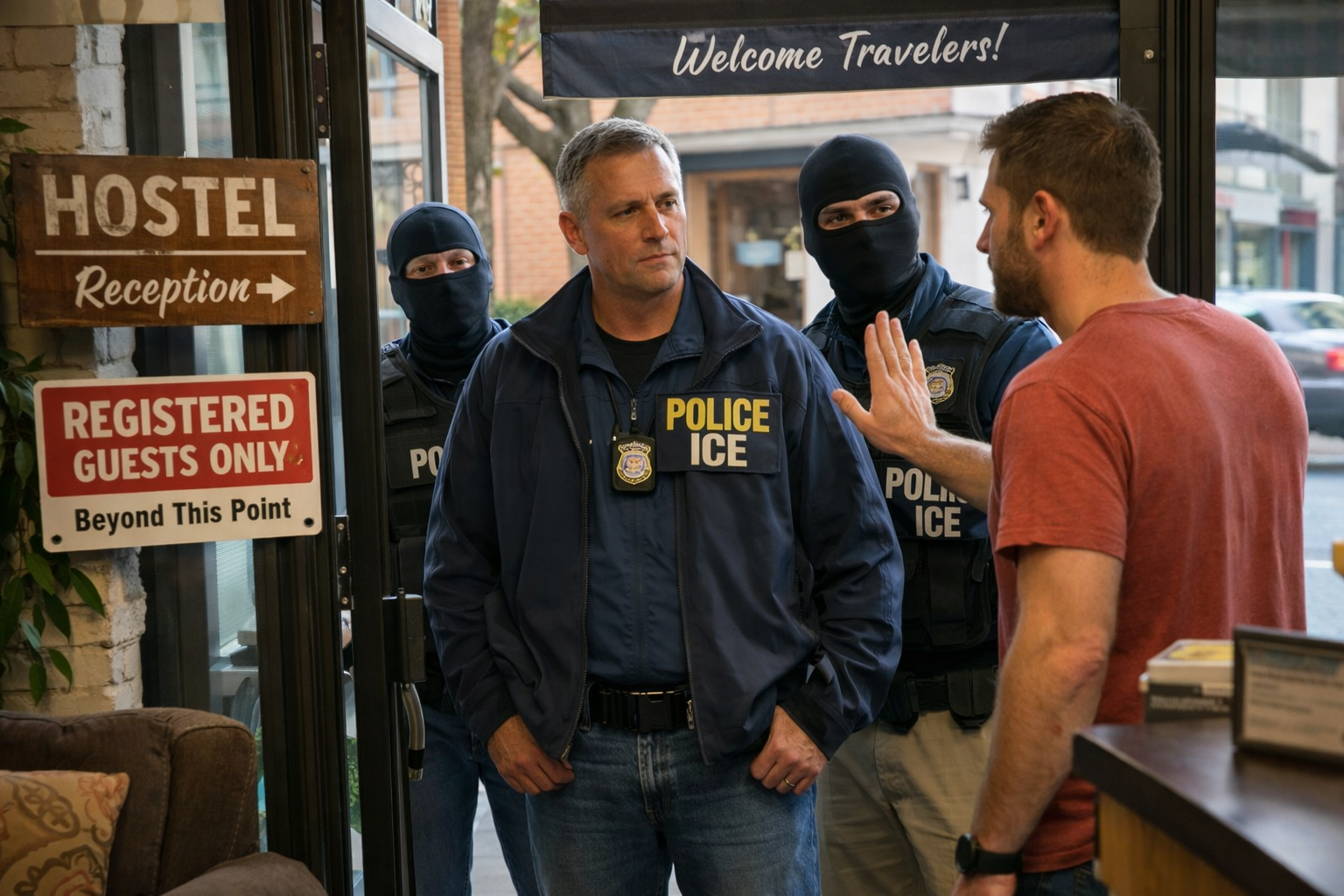
It's important to understand that, if immigration enforcement agents are following the law, they may only enter the public areas of a business without a judicial warrant. Access to private areas requires a warrant signed by a judge. Everything about how a hostel prepares for a potential ICE visit flows from this distinction.
In practice, this means the definition of “public” versus “private” space is not just a design decision—it is an operational and legal one. In many hostels, these boundaries evolve organically over time. A lounge that once welcomed walk‑in visitors may now function primarily as a guest space. A reception desk may be visible from the street but now may not be intended as a public service counter. Dorm corridors may feel communal but are not open to the general public.
If these distinctions are unclear, enforcement personnel may assume the entire property is publicly accessible. That assumption can quickly change the nature of an encounter.
Hostel operators should consider defining, in concrete terms, which areas are truly public and which are restricted to registered guests or staff. Dorm rooms and hallways, guest kitchens, staff offices, laundry areas, maintenance rooms, and staff housing are typically private environments—even when they feel informal or community‑driven.
Once these areas are clearly defined, preparedness becomes much more straightforward. Signage such as “Registered Guests Only,” “Private Property,” or “Employees Only” should convey public/private boundaries for ICE. Keeping doors to private areas closed and locked where appropriate reinforces those boundaries. Access control systems such as keycards, keypad entry, or coded locks can further clarify who is permitted to enter.
Some hostels may choose to rethink public access more broadly. Some hostels choose to limit entry to the entire hostel to registered guests and staff, including reception and lobby areas. This reduces ambiguity and ensures that any interaction with ICE begins at the front door, or in a clearly defined public space.
The goal is not to create barriers or change the spirit of hostel culture. It is to make it unmistakably clear where public access ends and private space begins, because that distinction determines how an enforcement encounter can legally unfold.
Understanding Warrants and Entry Authority
If immigration enforcement agents appear at your hostel, one of the first operational questions is whether they have legal authority to enter restricted areas. Not all warrants are the same, and staff should not be expected to interpret documents in the moment.
Every hostel should designate a trained point of contact responsible for interacting with enforcement personnel. This person should meet agents at the door or in a public area, request documentation, and immediately contact legal counsel. Other staff should defer to this individual and avoid engaging directly.
The purpose of this structure is to prevent confusion and ensure that decisions are handled consistently and professionally. It also reinforces the hostel’s responsibility to protect guest privacy and sensitive information.
Behavioral Protocol if Agents Appear
Behavior plays a critical role in any enforcement encounter. Panic, confusion, or uncoordinated responses can escalate a situation quickly, while calm and predictable behavior helps maintain control and helps keep everyone safe.
The most important principle is simple: remain calm and continue normal operations where possible. Staff and guests should not suddenly behave nervously or run for the nearest exit. These actions can give rise to "probable cause" and give the ICE officer the right to detain an individual. A single designated person (preferably a US citizen) should handle communication with ICE agents while everyone else continues their activities in the community.
This approach protects both the individuals involved and the overall environment of the hostel. When the community understands that there is a plan in place, the likelihood of panic or reactive behavior decreases significantly.
Hostels also manage sensitive personal information, including passport details, booking records, room assignments, and nationality data. Hostel operators have a responsibility to protect this information and should only share it when legally required by a subpoena or judicial warrant.
Training the Hostel Community
Preparedness cannot be a one‑time conversation. Hostels experience constant guest and staff turnover. Without ongoing reinforcement, protocols fade quickly.
Response planning should therefore become part of normal operations and informal conversations. When appropriate, talk about the plan to guests at check-in or during staff onboarding. Consider placing reminder placards in private areas of the hostel such as dormitories to remind everyone of their rights.
Constitutional rights (which apply to everyone within the boundaries of the US).
- Right to Remain Silent: Individuals can choose not to answer questions from law enforcement or immigration officers.
- Right to Request an Attorney: You can ask to speak with a lawyer before answering any questions.
- Protection Against Unlawful Entry: You do not have to allow entry into your home (i.e. hostel) without a valid warrant signed by a judge.
The goal of training is not to create fear. It is to create familiarity. When people know what to expect and how to respond, they are far more likely to remain calm and supportive of one another.
Communication During an Incident
Clear communication helps prevent panic and misinformation. Internally, management should be notified immediately, and staff should remain focused on their assigned responsibilities. Speculation and rumor can spread quickly in a hostel environment and should be avoided.
Guest communication should remain calm and neutral. Announcements that escalate fear can create unnecessary disruption, while measured communication helps maintain stability and trust.
Documentation is equally important. Operators should preserve security footage, take written notes, and record interactions where possible. These records may be important later to show if a persons constitutional rights may have been violated.
After Agents Leave
Once enforcement personnel leave the property, operational stability becomes the priority. Preserving recordings and documentation, recording a factual summary of events, and identifying anyone directly affected are immediate steps. Emergency contacts may need to be notified, and staff and guests may require reassurance. If it was not already done during the encounter, the incident should also be reported to the local Rapid Response Network so it can be documented and community support mobilized if needed.
Hostels function as communities, not just businesses. Even when no action is taken, the emotional impact of an enforcement visit can be significant. Re‑establishing a sense of safety is essential to restoring normal operations.
Preparation as Operational Risk Management
Preparedness is not about anticipating worst‑case scenarios. It is about ensuring the business can function under stress. Clear policies, thoughtful physical design (i.e signage and access controls), communication training, behavioral expectations, and documentation practices all contribute to resilience.
These measures protect guests, staff, operations, and brand reputation simultaneously. They also reinforce the professionalism and care that define strong hostel management.
What Comes Next
Operators are encouraged to develop written protocols, review property layouts and signage, train staff regularly, identify legal counsel in advance, and connect with local support resources where appropriate.
A later article will address our understanding of employment‑law including employer preparation, employment compliance (i.e. I-9 record-keeping), documentation practices, and planning for paper‑based enforcement actions.

