

The short version: Hostel revenue management is selling the right bed to the right guest at the right price through the cheapest channel that will actually deliver them. Most of the money is in a few disciplines done every week, not in clever software.
Why hostels need their own playbook
Hotel revenue management has a library of textbooks. Hostel revenue management has a forum thread and a spreadsheet someone inherited from the previous manager. That gap matters, because a hostel is not a small hotel. It sells beds, not rooms. One room can hold eight separate transactions on the same night, each from a different country, booked through a different channel, at a different price. A hotel revenue manager would find this either thrilling or deeply upsetting.
The fundamentals transfer, and the hostel version is in some ways more forgiving: more units, more price points, more ways to fill the last gap on a Saturday. The same flexibility gives you more ways to leak money quietly. This guide covers the full stack, from bed economics to the weekly routine that holds it together.
Operators compare notes on pricing and channels in the Hostel Reviews, Booking Engines, and Directories forum.
Bed economics versus room economics
Start with the asset. A private room is one unit of inventory. A six-bed dorm is six units of inventory that share one door, one bathroom queue and one air conditioner. The decision about how to configure your building is the largest revenue decision you will ever make, and most operators make it once, during the fit-out, then never revisit it.
The revenue-per-room test
Illustrative example: a hostel has a room that can be set up either as a six-bed mixed dorm or as a private double with ensuite.
- As a dorm at an average of $30 per bed and 80% occupancy: 6 x $30 x 0.80 = $144 per night.
- As a private at $95 and 70% occupancy: $95 x 0.70 = $66.50 per night.
On those numbers the dorm wins comfortably. But change the inputs (a market where privates sell at $140 and dorms struggle in the shoulder season at 55%) and the answer moves. The private now earns $98 against the dorm's $99, roughly a draw, with fewer linen changes and fewer 3am complaints. Run this test per room type, per season, at least once a year.
Costs that scale with heads, not rooms
Dorm revenue is higher per square metre, but so are some costs: linen, cleaning minutes, breakfast if included, wear on mattresses, and the staff time that goes into managing a room of strangers. A useful habit is to calculate a rough variable cost per occupied bed-night (housekeeping, laundry, amenities, payment fees) and a separate figure per occupied private room. Contribution per room, not revenue per room, is the number that decides configuration. There is no published benchmark for labour and laundry cost per bed-night that travels well between markets, so build yours from your own payroll and laundry invoices.
Female-only dorms and pod-style beds often command a premium, though how much varies too widely by city to quote a useful range. Price each as a separate room type so you see what the market actually pays.
The metrics that matter
Three numbers do most of the work. Learn them, report them weekly, and stop arguing about anything else until they are on the table.
ADR (average daily rate)
Total bed revenue divided by beds sold. In a hostel, calculate ADR per bed, not per room or per booking. A blended ADR across dorms and privates is useful for headlines but useless for decisions, so track it by room type as well.
Occupancy
Beds sold divided by beds available. A hostel at 95% occupancy is not necessarily a well-run hostel. It may simply be a cheap one. High occupancy with low ADR usually means you are leaving money on the table on peak nights.
RevPAB (revenue per available bed)
The hostel equivalent of RevPAR: total bed revenue divided by total beds available, or ADR multiplied by occupancy. This is the number that settles arguments.
Illustrative example: a 40-bed hostel.
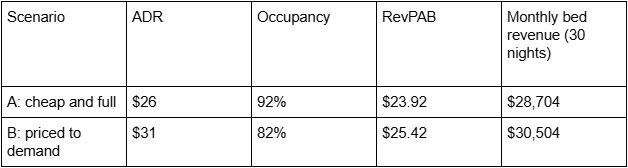
Scenario B sells fewer beds and makes $1,800 more a month, with fewer guests to clean up after. That is the whole argument for revenue management in one table.
Supporting metrics
Track net RevPAB (after commissions and payment fees, the honest version), plus booking window, length of stay, cancellation rate by channel, and pickup: beds booked for a future date in the past seven days.
Building a demand calendar
Dynamic pricing without a demand calendar is just guessing with extra steps. The calendar is a simple grid of the next 365 days, with each date given a demand level, usually on a five-point scale from "very low" to "very high".
What goes in it
- Seasonality: your own historical occupancy by month and day of week. Two years of data is far better than one.
- Events: festivals, concerts, sporting fixtures, conferences, university term dates, public holidays in your top source markets (not just your own country).
- Competitor signals: when nearby properties sell out or raise prices sharply, something is happening, even if you have not heard about it yet.
- Your own pickup: unusual booking pace for a date is the most reliable early warning you will get.
Keeping it alive
A demand calendar built in January and ignored until December is a decorative object. Review the next 90 days every week and the next 12 months monthly. When pickup for a date runs well ahead of last year's pace, move it up a demand level. When it lags, investigate before you discount.
A ready-made pricing calendar template is part of the free Hostel Operator Toolkit for members.
Dynamic pricing rules
Dynamic pricing in a hostel does not need to be sophisticated. It needs to be consistent. The aim is a set of written rules that any competent manager could follow on a Tuesday afternoon without asking the owner.
Set a base rate and a floor
For each room type, decide a base rate for a "normal" demand night and a floor below which you will not sell, whatever happens. The floor should sit above your variable cost per bed-night plus channel costs, with a margin for the fact that cheap beds attract a different guest mix. Never price to fill a bed at a loss unless you have a specific reason, such as a group booking that brings bar revenue.
Price by demand level
Illustrative rule set for a dorm bed with a $30 base rate:
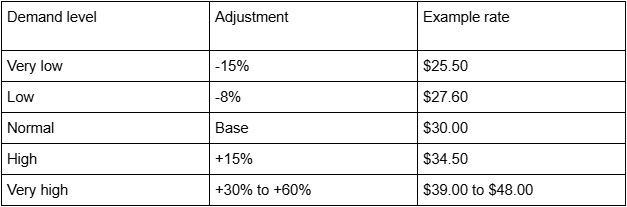
These percentages are illustrative. Your market sets the real ones.
Occupancy triggers
Layer occupancy-based steps on top of demand levels. For example: when a date passes 70% occupancy, raise the dorm rate by $2; at 85%, raise by another $3; at 95%, open only your highest rate plan. The logic is simple scarcity: the last beds on a busy night are worth more than the first.
Lead-time rules
Close to arrival, unsold beds become perishable. On low-demand dates, a modest last-minute reduction can convert walk-ins and same-day app searchers. On high-demand dates, do the opposite: hold your nerve, because late bookers on a sold-out weekend are rarely price-sensitive.
What not to do
Do not chase the cheapest competitor downward: if they are cheaper because they are worse, let them fill first. And do not let one person's mood set the rate. Rules exist so revenue is not a function of who opened the extranet that morning.
Length-of-stay rules
Length-of-stay controls are among the most underused tools in hostels, and they are free.
Minimum stay
On peak Saturdays, a two-night minimum (Friday and Saturday, or Saturday and Sunday) prevents the classic problem: Saturday sells out early to one-night guests while Friday and Sunday sit half empty. Use it on the dates where Saturday demand clearly exceeds supply, and remove it when pickup slows.
Closed to arrival and closed to departure
Closed to arrival (CTA) prevents bookings that start on a given date. If a festival runs Thursday to Sunday, closing Saturday to arrival protects beds for guests booking the whole event. Closed to departure (CTD) can stop a peak night being the first night of a short stay that leaves gaps behind it. Use both sparingly and review them weekly. Forgotten restrictions are a common reason a hostel mysteriously underperforms its own calendar.
Orphan nights
A single empty night between two bookings is hard to sell. Some tools handle this for you. As of November 2026, Smartpricing's help centre describes a feature that checks every two hours for nights that cannot be booked because of a minimum-stay restriction and lowers the minimum to one night so the gap can sell. SiteMinder's guide to gap nights suggests two routes: a secondary rate plan with a shorter minimum stay, priced slightly above your standard rate, or lowering the minimum on the specific problem dates. Check whether your own PMS or pricing tool does the same. If it cannot, check manually during the weekly meeting.
OTA mix and commission
Online travel agencies are the default distribution channel for most hostels. The question is not whether to use them, but how much of your inventory they should sell and at what cost.
The main players
For hostels, Hostelworld and Booking.com are usually the largest channels, with Expedia, Agoda and regional OTAs varying by market. There is no current public channel-share dataset for hostels worth quoting, so your own channel report is the benchmark that counts. Each has a different guest mix. Hostelworld traffic skews toward dorm-seeking backpackers; Booking.com often sells more privates and to a broader audience. Track performance per channel rather than assuming.
What commission really costs
Commission rates are set in each property's contract and vary by platform, country and programme, so the only number that matters is the one in yours. Optional visibility programmes add more. As of November 2026, Booking.com's "How we work" page says the commission a property pays, and whether it belongs to the Genius or Preferred Partner programmes, can affect its default ranking. Hostelworld's Elevate help page describes raising your commission level to move up its sort order.
But commission is only part of the cost. Add payment processing on whatever you collect, the cost of higher cancellation rates on flexible OTA rate plans, and the staff time spent reconciling invoices. Then compare that to the true cost of a direct booking, which is not zero. Our companion column runs the full numbers: Direct Booking vs OTA: Real Margin Math for a 40-Bed Hostel.
Setting a target mix
There is no correct OTA share. A new hostel with no brand may sell almost everything through OTAs, and should, because the alternative is empty beds. The useful question is directional: is your direct share rising year on year, and is your net RevPAB rising with it?
Managing visibility
OTA ranking is influenced by factors you can observe and partly control. As of November 2026, Booking.com says its default "Our top picks" order rewards properties that do well on click-through rate, gross bookings and net bookings (bookings minus cancellations). Hostelworld's Elevate page lists quality signals such as guest reviews, location, traveller behaviour, historical performance and live pricing, alongside economic signals such as average bed price, historical production and commission level. We look at the Hostelworld side in more depth in What Hostelworld's Algorithm Rewards in 2027.
Closing out inventory on an OTA during busy periods can protect margin, but it can also cost ranking you will want back in the low season. Treat each channel as a relationship with a memory.
Channel managers
If you sell on more than one OTA, you need a channel manager. Manual updates across extranets are how overbookings happen, and an overbooked dorm at 11pm is a uniquely educational experience for a night manager.
What a channel manager should do
- Push availability and rates from your PMS to every connected channel in near real time.
- Pull bookings back into the PMS automatically.
- Support bed-level inventory, not just room-level, so dorms are sold correctly.
- Handle rate plans, restrictions (minimum stay, CTA, CTD) and derived rates.
- Log every change, so you can see who altered what and when.
Choosing one
Ask for hostel references, confirm your OTA connections are two-way, and test how dorm beds map across channels before you sign. The B2B Services Directory lists channel manager and PMS providers that work with hostels.
Rate parity
Rate parity means offering the same price for the same room and conditions across all channels. Historically, OTAs required it contractually. The legal picture has changed considerably, particularly in Europe, where several countries restricted parity clauses and the EU Digital Markets Act places obligations on designated gatekeepers.
The European Commission designated Booking as a gatekeeper for its online intermediation service, Booking.com, on 13 May 2024. The Commission's DMA factsheet of 28 September 2026 states that, under Article 5(3), businesses using Booking.com in the European Economic Area can set their prices and conditions freely on and off the platform, including on their own websites. National laws and other OTAs' contracts are a separate question. Rules differ by country and contract, so read yours.
Why parity still matters in practice
Even without contractual parity, some platforms still compare your prices with other channels, and practice differs. As of November 2026, Hostelworld's Elevate page lists a Net Competitiveness Score, which compares your price and availability with other channels, among its ranking signals. The Commission's DMA factsheet, by contrast, says external prices are not used for Booking.com's default ranking.
More often the problem is accidental: a stale rate, a currency rounding issue, a promotion that never ended. Guests notice, OTAs notice, and neither reacts kindly.
Giving direct guests a better deal without breaking anything
The common approach is to keep the headline rate in parity and add value for direct bookers: free breakfast, a welcome drink, a late checkout, a locker included, or a member rate for guests who sign up. Value-adds are easier to defend than lower prices, and they cost you less than the commission you save.
Monitor it
Check your rates across channels at least weekly, ideally with automated alerts. Disparities are usually mistakes rather than strategy, and they tend to surface first in angry reviews. HostelManagement.com's OTA Listing Verification and Alerts service is one way to catch them.
The direct booking engine
Your website is a channel. Treat it like one, with its own conversion rate, cost and owner.
Minimum standard
- A booking engine that loads fast on mobile and shows live availability by bed type.
- Prices displayed clearly in the guest's currency, with taxes and fees shown upfront.
- Two or three steps from search to confirmation, not seven, with secure payment in methods your source markets use.
For a comparison of what is on the market, see The Ultimate Guide to Hostel Booking Engines.
Driving direct traffic
Direct bookings are not free. They come from metasearch (Google hotel listings and similar), paid social, email to past guests, partnerships, and the guests who find you on an OTA then search for your name. The last group is often the largest and the cheapest, which is one reason a strong OTA presence and a strong direct channel are not enemies.
Measure cost per direct booking by source. If it costs you more to win a direct booking than an OTA would have charged, you have not saved money, you have just moved the cost to a different line.
Repeat guests and groups
Two segments deserve a direct-only focus. Past guests, because you already paid to acquire them once. Groups, because group bookings through OTAs are expensive and awkward, and a simple group enquiry form on your site with a fast reply often wins them.
Ancillary revenue
Beds pay the rent. Ancillary revenue often pays the profit. A hostel that makes nothing beyond the bed is leaving its most loyal customers, the ones already in the building, with nowhere to spend.
The main streams
- Bar and F&B: usually the largest ancillary line where licensing allows. Drinks usually carry better margins than food, though the gap depends on your pricing, wastage and licensing costs, so work out your own. A busy bar also improves reviews and length of stay.
- Breakfast: either included (a conversion tool) or sold separately (a revenue line). Test both.
- Tours and activities: commission from local operators, or your own walking tours and pub crawls. Low cost, high guest satisfaction when done well.
- Lockers, towels and padlocks: small amounts that add up across thousands of bed-nights. Be careful: charging for basics can hurt reviews. Some operators include the locker and charge for the padlock.
- Laundry, luggage storage and late checkout: convenience revenue guests are usually happy to pay. Merchandise works only for hostels with a real brand following; otherwise it gathers dust behind reception.
Measure it per guest
Track ancillary revenue per occupied bed-night. Illustrative example: if the 40-bed hostel above sells 984 bed-nights a month and ancillary revenue is $4,900, that is about $5 per bed-night. Raising it to $7 adds roughly $2,000 a month, which is more than the RevPAB improvement in our pricing example and requires no change to rates.
Total revenue, not just room revenue
The mature approach is to measure total revenue per available bed (TRevPAB): beds plus ancillaries. It changes decisions. A group of twelve booking direct at a modest discount, who will spend heavily at the bar, may be worth more than twelve full-price individual guests who go to bed at ten.
The weekly revenue meeting
All of the above collapses without a routine. The weekly revenue meeting is where pricing becomes a habit instead of a crisis response.
Who attends
The owner or general manager, whoever controls rates and the channel manager, and ideally the front desk lead, who hears what guests actually say about price. Thirty to forty-five minutes. Same day, same time, every week.
Standing agenda
- Last week: occupancy, ADR, RevPAB and net RevPAB against budget and last year, by room type.
- Channel mix: share of bookings and revenue by channel, cancellations by channel.
- Pickup review: the next 30, 60 and 90 days against last year's pace.
- Demand calendar: new events, changed dates, competitor moves.
- Rate and restriction changes: agree specific changes, who makes them, and when.
- Parity and listing check: any disparities, broken photos, outdated descriptions or policy errors flagged across channels.
- Ancillary performance: revenue per bed-night, what is selling and what is not.
- Actions: written down, with owners, reviewed at the start of next week.
Keep a decision log
Record every significant rate or restriction decision with a one-line reason. Six months later, when someone asks why April underperformed, you will have an answer that does not begin with "I think".
If you want other operators' views on how they run this meeting, ask in the General Hostel Operations forum.
Putting it together
Revenue management is not a product you buy. It is a set of decisions made on purpose rather than by default: rooms configured for contribution, a living demand calendar, written pricing rules, OTAs treated as a paid channel with real value, clean parity, a direct channel that earns its keep, and a weekly meeting that does it all again.
None of it is glamorous. All of it compounds.

