
Walk into a busy hostel at six in the evening and you can see the problem before anyone explains it.
Backpacks are stacked beside the entrance. A traveler who arrived from the airport is checking the time on their phone. Someone else is asking where to find their room. Another guest wants to extend their stay. A fourth is waiting to pay for a locker. Behind the reception counter, one employee is attempting to solve all of these problems at once while a queue quietly becomes a crowd.
For a conventional hotel, this is an operational inconvenience. For a hostel, it can become a defining moment in the guest experience.
Hostels operate around movement. Guests arrive at different hours, stay for shorter periods, change rooms, add nights, purchase extras, store luggage, ask for local recommendations and leave again. The very flexibility that makes hostels attractive also creates a remarkably demanding front-desk environment.
That is where the self-service check-in kiosk has moved from an interesting piece of hospitality technology to a serious operational consideration.
The proposition sounds straightforward: allow guests to complete routine arrival and departure tasks without waiting for an employee. But the real business case is more interesting than simply replacing a few minutes of receptionist labor. A properly implemented kiosk can change the economics of the front desk, reduce congestion, create new opportunities for ancillary revenue and give staff more time to perform the distinctly human work that guests actually remember. The important word is properly.
A kiosk installed as a glorified tablet in the corner of reception will not automatically improve a hostel. Technology can remove friction, but poorly designed technology simply moves the friction somewhere else. The question for hostel owners, therefore, is not whether a kiosk looks modern. It is whether the technology can produce measurable operational value without damaging the social character that makes hostel hospitality different. The evidence increasingly suggests that it can.
The Front Desk Has Become a Capacity Problem
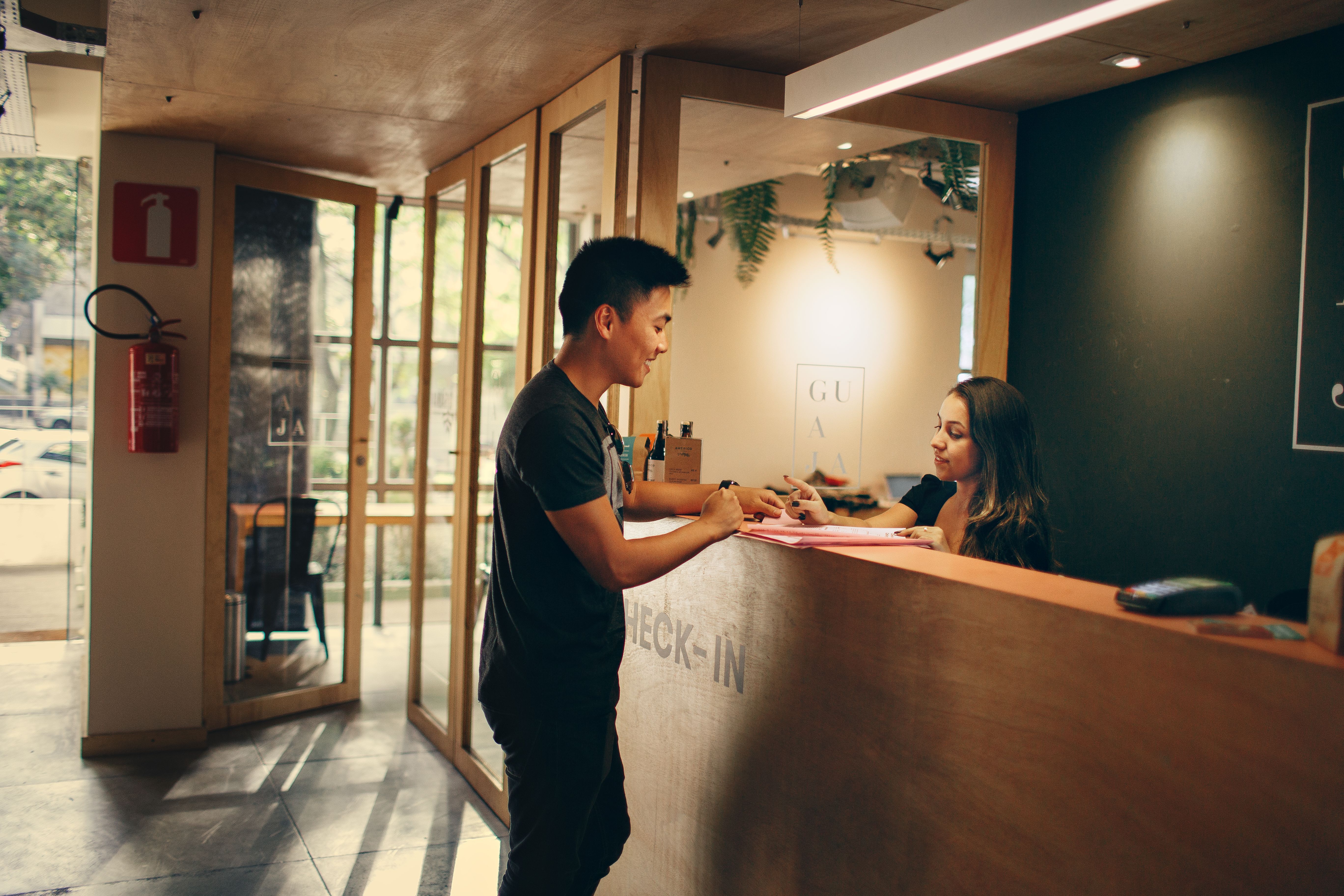
The traditional hostel reception model assumes that every transaction requires a person. A guest arrives. A receptionist verifies the reservation. Identification is checked. Payment is confirmed. Registration information is completed. A bed or room is assigned. Access credentials are issued. House rules are explained. Questions are answered. None of these tasks is particularly difficult in isolation.
The problem emerges when twenty guests arrive within the same thirty-minute window. At that point, the front desk becomes a bottleneck. Hospitality technology research has increasingly identified operational efficiency during periods of high occupancy as a major reason for investment. In its 2024 Travel Technology Investment Trends research, Amadeus reported that improving operational efficiency during high occupancy was a primary focus for 43 percent of surveyed hospitality technology leaders. The same research found that hospitality leaders expected technology investment to increase by an average of 16 percent over the following twelve months.
For hostel owners, this distinction matters. A front desk is not simply a place where reservations are processed. It is a finite amount of staff capacity. Every minute an employee spends typing information that a guest could safely enter themselves is a minute unavailable for solving a complicated booking problem, helping a distressed traveler, resolving a room issue or creating the kind of spontaneous interaction that differentiates a hostel from a generic accommodation provider. Automating the front desk, therefore, should not be understood as removing the front desk. It is better understood as changing what the front desk is for.
What a Self-Service Check-In Kiosk Actually Does
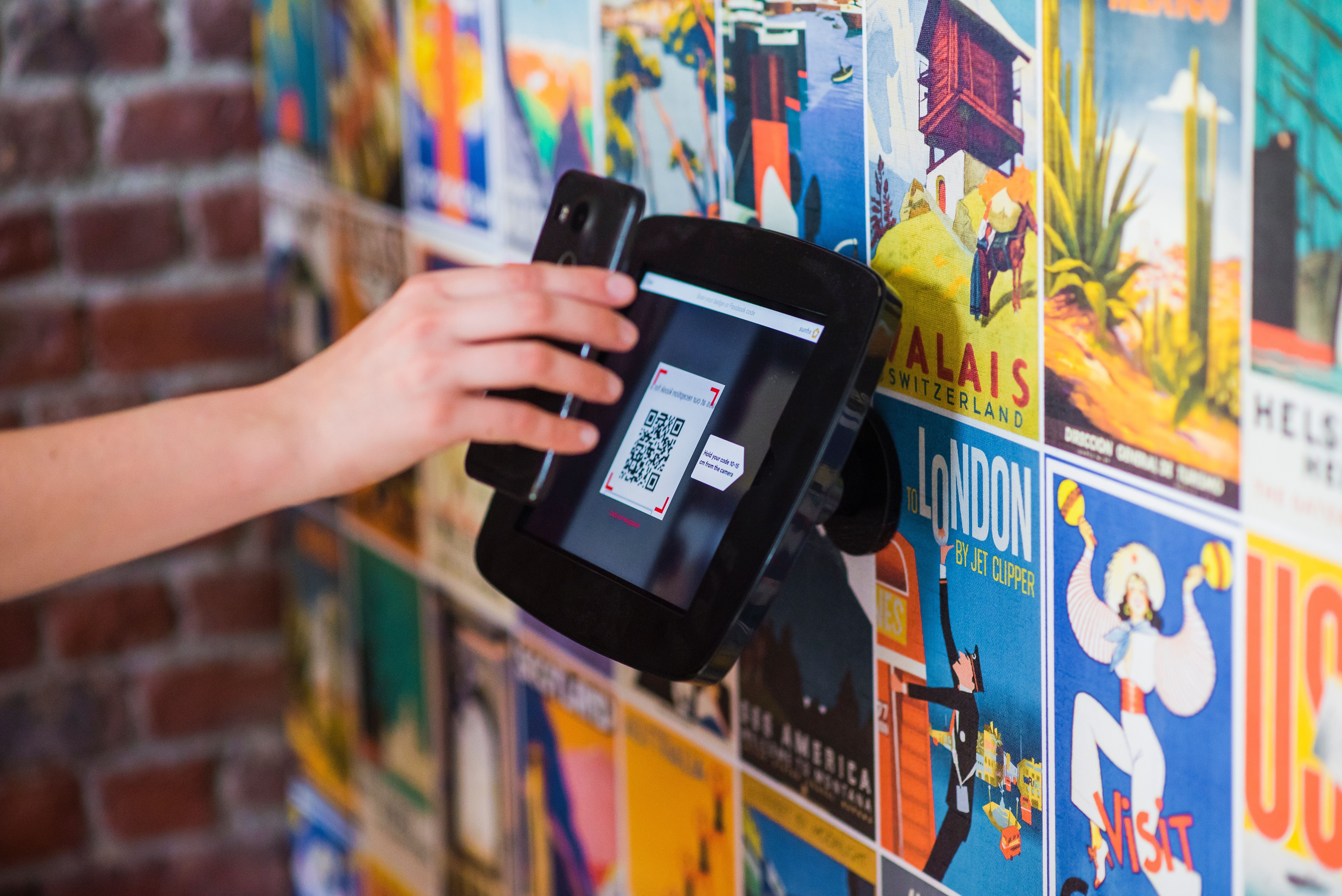
A modern self-service check-in kiosk is essentially a guest-facing interface connected to the hostel's operational systems. The exact capabilities vary by technology provider, but the strongest implementations can allow travelers to identify their reservation, complete required registration information, confirm or make payments, receive access credentials where the property's hardware supports it, review relevant information and complete departure procedures without requiring an employee to perform every step.
This is important because the value does not come from the screen itself. The value comes from integration. A disconnected kiosk creates another administrative system for staff to monitor. An integrated kiosk can become an extension of the property's reservation and guest-management infrastructure. When a reservation changes in one system, the guest-facing experience should reflect that change. When a guest completes a transaction, staff should not have to re-enter the same information somewhere else. That distinction is one of the first questions an owner should ask a technology vendor.
Do not ask only, "Does the kiosk check guests in?" Ask instead, "What happens to the information after the guest checks in?". The answer reveals whether the technology is genuinely automating work or merely creating a different interface for the same work.
The Evidence Behind Guest Acceptance
There was once a reasonable assumption that travelers wanted a person standing behind a desk when they arrived. That assumption is becoming less universal. In June 2025, Mews published research based on a survey of 2,000 American travelers. Seventy percent said they were likely to check themselves into a hotel using an application or self-service kiosk rather than a traditional front desk. Among Generation Z travelers, the figure reached 82 percent. The same research found that 82 percent of current hotel loyalty members reported frustrations with existing hotel processes, including lengthy check-in and limited flexibility.
Those figures should not be interpreted as proof that every hostel guest wants a completely automated arrival. They are evidence of something more useful: a large segment of travelers considers self-service a legitimate hospitality experience rather than an inferior substitute for human service. That distinction is crucial. A hostel owner does not need every guest to use a kiosk. The goal is to give guests an appropriate choice. A traveler arriving after a twelve-hour journey may want to walk directly to their bed. Another traveler may want to ask a receptionist about the best neighborhood for nightlife. A third may have a complicated reservation involving multiple people and require assistance. The strongest self-service model accommodates all three.
Research published in the International Journal of Hospitality Management in 2024 provides an important counterweight to the enthusiasm surrounding automation. Researchers studying hotels that introduced self-service kiosks examined changes in customer satisfaction and found that the introduction of self-service technology can affect satisfaction in meaningful ways.
Other research is even more explicit about the limits of automation. A 2024 study involving 378 guests at four large resorts found that in-person check-in produced stronger effects on customer satisfaction and emotional engagement than self-service check-in when the arrival interaction itself was perceived as significant. For hostel operators, that is not an argument against kiosks. It is an argument against treating kiosks as replacements for hospitality.
The Hostel Advantage: Staff Can Stop Processing and Start Hosting
There is an irony at the heart of front-desk automation. The technology that appears to make hospitality less human can actually give hospitality workers more time to behave like hosts. Consider the arrival process. If a guest completes the routine components of check-in independently, the receptionist no longer needs to spend several minutes collecting information that the system already knows. Instead, the employee can notice that the guest is carrying a surfboard and recommend a nearby beach. They can explain the evening event. They can help a traveler understand public transportation. They can notice that someone looks exhausted and offer practical assistance rather than simply pointing toward a registration form.
This is the difference between automating hospitality and automating administration. Amadeus has made a similar argument in its hospitality technology research, emphasizing that technology should free employees to concentrate on guest-facing work rather than eliminate the human element. Its research also found that hospitality leaders increasingly view technology as a mechanism for improving operational efficiency while supporting better guest experiences. That philosophy is particularly compatible with hostels. The front desk should not become a vending machine. It should become a place where guests go when they actually need a host.
The Economics of a Kiosk
This is where the conversation becomes more serious for owners. A self-service kiosk has an acquisition cost. Depending on the provider and configuration, there can also be software fees, payment-processing costs, installation costs, hardware maintenance, connectivity requirements and integration expenses. So the business case should never be based on the vague claim that "automation saves labor." The calculation needs to begin with actual hostel operations. Imagine a property processing 80 arrivals on a busy day. Suppose a routine arrival currently requires an average of six minutes of staff time. That represents 480 minutes, or eight hours, of front-desk activity devoted purely to those arrivals.
If a kiosk eventually handles half of those arrivals and reduces the average staff involvement for those transactions to one minute, the theoretical staff time released is substantial. But that does not automatically mean the hostel can remove an employee. This is where simplistic return-on-investment calculations go wrong.
The value of released labor can appear in several forms. It may reduce overtime. It may allow one employee to cover a larger operational period. It may reduce the need for temporary staff during peak seasons. It may allow an owner to redeploy reception employees toward revenue-generating or guest-facing responsibilities. It may also prevent service deterioration when occupancy spikes.
The correct calculation is therefore not simply the salary of a receptionist divided by the cost of a kiosk. It is the value of capacity recovered from the front desk. A useful way to think about the calculation is this:
Annual return from automation = labor capacity recovered + incremental revenue + avoided operational cost − technology operating cost
The capital investment can then be compared against the annual benefit to estimate the payback period. Consider a deliberately conservative hypothetical example. Suppose a hostel invests $12,000 in a kiosk and associated implementation. If the technology creates $500 in measurable monthly labor capacity and contributes another $300 per month through additional upselling and reduced transaction friction, the property would generate $800 of monthly benefit before ongoing software and maintenance costs. At that level, the theoretical payback period would be fifteen months before operating costs.
The numbers are illustrative, not an industry benchmark. Every hostel should replace them with its own wage rates, arrival volume, transaction times, occupancy patterns and technology costs. But the principle is important. The best kiosk investment is not the one with the cheapest hardware. It is the one that creates the largest measurable improvement in the economics of the guest journey.
The Revenue Opportunity Hiding Inside Check-In
There is another financial dimension that is easy to overlook. Check-in is one of the few moments when a guest is already thinking about their stay. They may need luggage storage. They may want an earlier arrival. They may be considering a room upgrade. They may need a towel, locker, transportation option or activity. They may be interested in an event taking place that evening. A traditional receptionist can certainly sell these products. But the interaction can become awkward. The employee has to remember what is available, explain it quickly and determine whether the guest is interested while simultaneously managing the queue.
A digital interface can present relevant options consistently.
Mews reported in its 2025 research that guests checking in through its kiosk were three times more likely to purchase an upsell and generated nearly 70 percent more upsell revenue per check-in than guests using the front desk. Mews also reported that approximately 30 percent of guests at its kiosk-enabled United States hotels checked in through the kiosk, compared with a global benchmark of 20 percent. These are provider-reported results rather than an independent industry benchmark, but they illustrate the commercial potential of putting carefully designed offers directly into the arrival journey.
This is especially interesting for hostels because ancillary revenue can be structurally important. A bed may have a relatively fixed nightly price. The guest's total value to the property does not. A kiosk can turn arrival into another revenue opportunity without requiring an employee to deliver a sales pitch to every traveler. The technology can quietly ask whether the guest wants luggage storage, an early arrival, an additional night or another available service. The best version does not feel like advertising. It feels like assistance.
A Real Hostel Example
The theory becomes more convincing when it reaches an actual hostel.
THIS HO(S)TEL in the Netherlands implemented Mews technology, including a kiosk, as part of an effort to simplify check-in and check-out while maintaining the guest experience. According to the published customer case study, guests can use the kiosk to check themselves in, while the system can also support services such as early arrival, luggage storage and other guest needs. The property specifically identified time savings, cost reduction, automation and guest experience among the outcomes it was pursuing.
Another example comes from Generator Miami. In Mews' 2025 research, Generator's global brand marketing director described its self-check-in kiosks as an important part of creating a seamless arrival experience and emphasized that guests could arrive on their own terms while staff remained available for more meaningful interactions.
These examples matter because they challenge the idea that kiosk technology belongs only in large, standardized hotels. The hostel environment can actually make the case stronger. High turnover, variable arrival times and lean staffing create exactly the conditions in which routine administrative work becomes expensive.
The Biggest Mistake: Automating the Wrong Part of the Experience
A hostel owner can purchase excellent technology and still create a terrible arrival experience. The problem usually begins when the implementation is designed around the internal system rather than the traveler. Imagine a guest arriving at midnight after navigating an unfamiliar city. The kiosk asks for information they already entered during booking. The screen is difficult to read. The payment process fails. The system does not recognize their reservation. The room number appears without clear directions. The guest cannot understand how to obtain their access credential.
The property has technically automated check-in. The guest has experienced technological failure. That is not automation. That is friction with a touchscreen. The interface therefore needs to be designed around the actual arrival journey.
The guest should understand what to do without requiring a staff member to explain every screen. The system should recognize returning information wherever legally and operationally appropriate. Payment should be straightforward. Language support should reflect the property's international audience. Instructions should be visually clear. Accessibility should be considered from the beginning rather than added later.
And there must always be an escape route. When a guest cannot complete the process, they need immediate access to a person. This is especially important in hostels, where guests can arrive tired, inexperienced, intoxicated, anxious, unfamiliar with local systems or simply uncomfortable with technology. Self-service should reduce waiting. It should never create helplessness.
Why Integration Matters More Than Hardware
From a technology vendor's perspective, the most impressive kiosk is not necessarily the most valuable kiosk. A beautiful screen does not create operational efficiency. Integration does. The kiosk should ideally communicate with the hostel's reservation environment, payment infrastructure and access systems so that information flows between guest and property without unnecessary manual intervention. The fewer times staff have to copy information from one system to another, the greater the real automation.
This is why owners should evaluate the entire workflow before purchasing hardware.
What happens when a reservation is modified?
What happens when a guest arrives early?
What happens when the assigned bed changes?
What happens when payment fails?
What happens when a guest needs to extend their stay?
What happens when a room is unavailable?
What happens when the kiosk loses its internet connection?
What happens when the guest needs a physical key?
What happens when the hostel's overnight team needs to intervene?
A kiosk that handles the happy path beautifully but forces staff to manually repair every exception may create less value than a simpler system with better integration.
The Human Touch Is Not the Enemy
There is a persistent misconception that travelers are choosing between technology and hospitality. The evidence is more complicated.
Oracle Hospitality and Skift's 2022 global survey of 5,266 consumers and 633 hotel executives found that 73 percent of travelers wanted technology that minimized contact with staff and other guests, while 38 percent said they wanted a fully self-service hotel experience with staff available upon request. At the same time, the findings showed that travelers were not uniformly demanding a completely contactless stay.
More recent Amadeus research reinforces that distinction. Its Travel Dreams research found that 48 percent of leisure travelers preferred a traditional hotel check-in desk with a person available to explain amenities, compared with only 13 percent who wanted a check-in process with no staff support at all. Business travelers showed a markedly different preference, with 71 percent favoring some form of online or self-service check-in. For hostels, this creates a powerful design principle. Give guests control over how much human interaction they want.
Measuring Guest Satisfaction After Installation
The most dangerous assumption an owner can make is that a kiosk is successful because guests use it. Usage is only the beginning. A serious implementation should establish a baseline before installation and compare it with performance afterward.
The property should know how long the average arrival takes. It should know how many guests arrive during peak periods. It should know how often the front desk becomes congested. It should know how much staff time is spent processing routine arrivals. It should understand the frequency of check-in errors, payment problems and guest complaints related to arrival.
After deployment, the same measurements can reveal whether the investment is working. The property can compare average transaction duration, kiosk adoption, staff intervention rates, abandoned transactions, upsell conversion, guest satisfaction scores and arrival-related complaints. Most importantly, the hostel should examine whether staff are actually spending more time with guests. That is one of the strongest indicators of successful automation. If the kiosk handles routine transactions but employees remain buried in administrative work, the technology has not transformed the operation. If the queue disappears and staff suddenly have time to welcome guests, solve problems and create experiences, the investment is doing something much more valuable. It is changing the character of the workplace.
The Security and Privacy Question
Self-service also introduces responsibilities that cannot be treated casually. A kiosk can process names, reservation information, identification details, payment information and other personal data. The exact requirements depend on jurisdiction, system architecture and the types of information collected. That means the technology vendor's security practices matter. So does the property's own configuration. Owners should understand where guest information is stored, how it is transmitted, how long it is retained, who can access it and what happens when a guest completes the process.
Payment handling should use appropriate payment infrastructure rather than storing sensitive payment information unnecessarily. Staff access should be controlled. Physical placement should reduce opportunities for other guests to view private information on the screen. The arrival experience may be self-service. The responsibility for protecting the traveler is not.
When a Kiosk Makes Sense for a Hostel
A self-service check-in kiosk tends to make the strongest operational case where arrival volume is high, staffing is lean and a meaningful proportion of guest interactions are routine. A property with highly variable arrival times can benefit particularly strongly because the technology can remain available outside the periods when a full reception team would otherwise be economical. A hostel with frequent international arrivals may also benefit from multilingual interfaces and standardized instructions. A property selling numerous ancillary services can use the arrival journey to present relevant offers consistently. And a hostel experiencing recurring queues during peak arrival periods has an obvious operational problem for the technology to address. But a kiosk is not automatically the right investment for every property.
A very small hostel with low arrival volume and a highly personal service model may gain little from the additional technology. A property with unreliable connectivity or incompatible access systems may face disproportionate implementation difficulties. A hostel whose guests routinely require complex assistance at arrival may discover that automation removes less work than anticipated.
The investment should follow the operational problem, not the technology trend.
The Future of the Front Desk Is Probably Not a Desk
The more interesting question is not whether kiosks will eliminate reception. It is whether the traditional concept of reception will gradually disappear.
The hospitality industry is already moving toward connected guest journeys in which booking, payment, arrival, access, communication, and in-stay services are increasingly integrated. Amadeus reported in 2024 that self-service technology ranked among the technologies hospitality leaders expected to have significant impact on the industry, while its research showed that improving efficiency during periods of high occupancy remained a major technology priority.
That trajectory points toward a different kind of hostel reception. Instead of a counter where every guest must stop, the arrival area becomes an operational hub surrounded by optional digital touchpoints. Some guests check themselves in. Some speak with a host. Some complete their arrival on their phones. Some need assistance from a remote employee. The common denominator is choice. For hostel owners, this may ultimately be the most important lesson. The purpose of technology is not to make the hostel feel like an airport terminal. It is to remove the administrative obstacles that prevent the hostel from feeling like a hostel.
The Return on Investment Is More Than Labor Savings
A self-service check-in kiosk should therefore be judged on more than the number of receptionist minutes it eliminates.
Its return on investment can come from several directions at once.
There is the direct value of staff capacity recovered from routine transactions. There is the value of shorter queues and fewer peak-period bottlenecks. There is the potential for increased ancillary revenue through consistent and timely offers. There is the operational value of extending self-service availability beyond staffed reception hours. There is the potential reduction in repetitive errors. And there is the less easily quantified value of giving employees more time to provide meaningful hospitality.
Research supports the broader direction, but it also warns owners against oversimplification. Guests increasingly accept and sometimes prefer self-service, yet many still value human interaction, particularly when arrival is emotionally or practically significant.
The winning model is therefore not "technology instead of people."
Brief Recap
For busy hostels, a self-service check-in kiosk can improve the economics of reception by shifting routine transactions away from staff, reducing arrival congestion and creating additional opportunities for ancillary revenue. Recent hospitality research shows growing traveler acceptance of self-service, while other research demonstrates that human interaction remains important for many guests.
The strongest implementation does not attempt to eliminate hospitality. It automates predictable administrative work so hostel employees can spend more time doing what technology cannot easily reproduce: welcoming travelers, solving problems, offering local knowledge and creating community.
The return on investment should therefore be measured through recovered staff capacity, reduced friction, additional revenue and guest experience rather than hardware cost alone.
The best kiosk is not the one that replaces the most human interaction.
It is the one that makes every human interaction more valuable.
References
Wu, Xiaojun, Hanxiao Xiang, Yize Wang, and Yixi Huo. “How Does Customer Satisfaction Change After Hotels Start Using Self-Service Kiosks?” International Journal of Hospitality Management 122 (2024): 103872.
Mews. “70% of Travelers Would Skip the Front Desk, Mews Survey Reveals: The Rise of Self-Check-In Hotels.” June 11, 2025. Mews research and survey methodology
Amadeus Hospitality. “Hoteliers Prioritize Personalization as They Significantly Increase Investment, Finds New Amadeus Research.” May 16, 2024. Amadeus Hospitality research
Oracle Hospitality and Skift. “Travelers Want High-Tech, Low-Touch Hotel Stays.” June 1, 2022. Oracle Hospitality survey findings
Amadeus Hospitality. “Travel Dreams Report.” Research on traveler preferences for hotel check-in experiences.
Mews. “THIS HO(S)TEL Becomes That High-Performing Communal Hub With Mews.” Customer case study. THIS HO(S)TEL customer case study
Mews. “Hotel Kiosk Software for Check-In.” Product documentation and reported kiosk performance data. Mews Kiosk overview
Deloitte. “Travel Leaders Embrace Automation and Tech as Workforce Challenges Continue to Weigh on Industry.” Research on automation and self-service adoption across travel and hospitality. Deloitte travel industry research

