
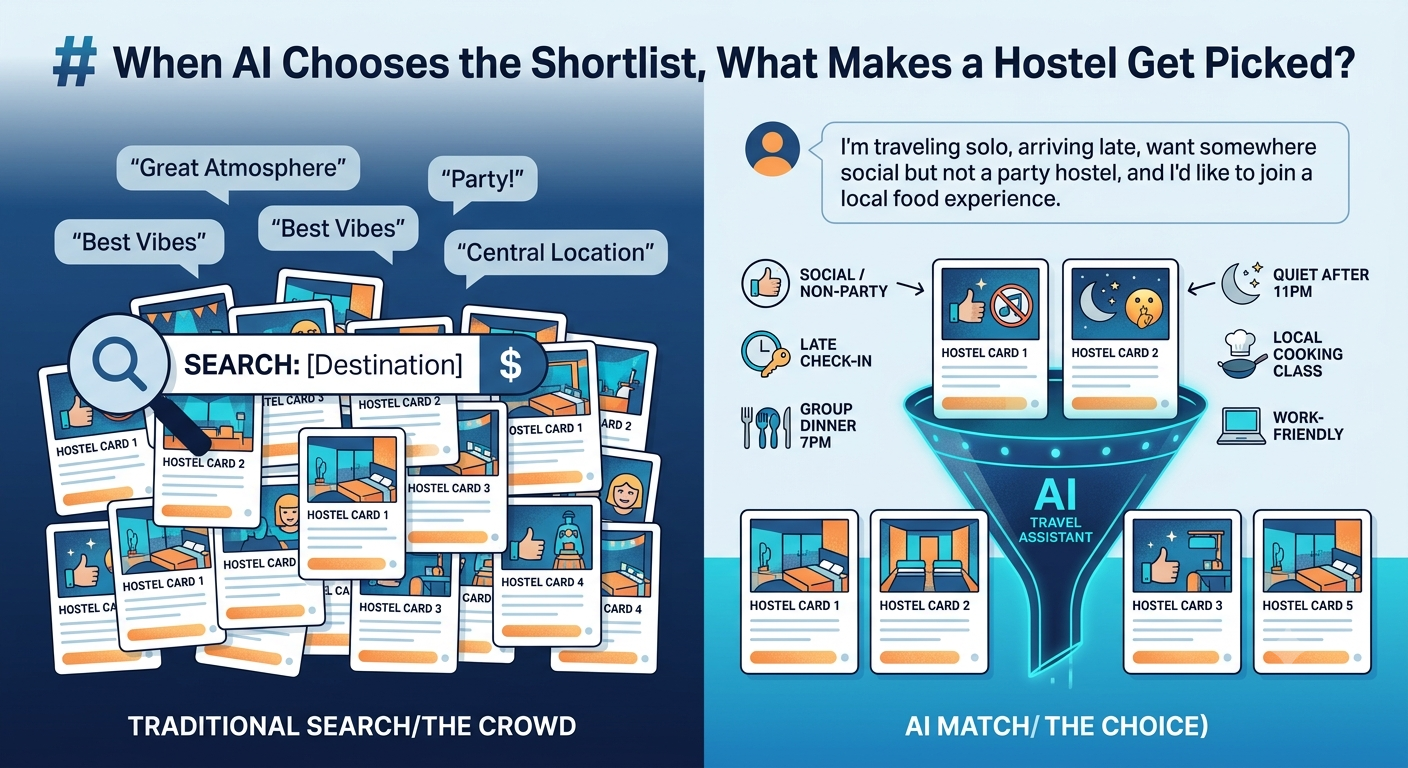
Hostels have spent years optimizing rankings, reviews and conversion. AI introduces a different challenge: making sure the property can be understood well enough to be selected in the first place.
For most of the OTA era, hostel distribution followed a relatively familiar pattern.
A traveler searched a destination.
A platform returned dozens of properties.
The hostel competed on position, price, reviews, photos and conversion.
AI-assisted travel changes one important part of that process.
The traveler can increasingly describe what they want, rather than where they want to search.
“I'm traveling solo, arriving late, want somewhere social but not a party hostel, and I'd like to join a local food experience.”
Instead of browsing 50 hostels, the traveler may get five.
That creates a new distribution question:
What makes an AI system decide that your hostel belongs in those five?
From being visible to being understandable
This is the part of AI distribution that hostel operators may underestimate.
Search engines largely ask:
Which pages are relevant to this query?
OTAs ask:
Which properties are most likely to convert?
An AI travel assistant increasingly has to answer something slightly different:
Which property is the best fit for this particular traveler?
That requires more than a ranking signal.
It requires an understanding of the product.
And this is where hostels have an unusual problem.
A hostel's strongest selling points are often the least standardized ones.
A hotel can be described relatively easily:
four-star property
200 rooms
airport shuttle
swimming pool
500 metres from the station
A hostel may be selling something more like:
easy to meet people without being a party hostel
good for solo travelers
guests often join activities together
social in the evening but quiet after midnight
strong local connection
relaxed rather than highly organized
These differences are commercially meaningful.
But they are often expressed through vague marketing language rather than clear product information.
“Great atmosphere” tells a traveler very little about what their actual stay will feel like.
And it gives an AI system even less to work with.
The hostel product is becoming more specific
This is why the next competitive advantage may not be better copy.
It may be better definition.
Consider two hostels.
Hostel A says:
“A vibrant, welcoming hostel in the heart of the city, perfect for adventurous travelers.”
Hostel B says:
“Most guests are solo travelers. We run a small group dinner every evening at 7 p.m. The common room is social until around 11 p.m., while dorms are expected to stay quiet after midnight. We have four-, six- and eight-bed dorms, plus private rooms.”
Hostel A sounds better.
Hostel B is easier to choose.
The second description gives a traveler — and an AI system — enough information to make a judgment.
Who stays here?
What happens here?
When does it happen?
How social is it?
How quiet is it?
What kind of room can I book?
Those questions are becoming part of the product itself.
This matters most for hostels with a strong identity
There is an interesting paradox here.
AI could actually benefit distinctive hostels more than generic ones — if that distinctiveness is clearly expressed.
A hostel that is genuinely known for something has an advantage when travelers start searching by intent.
For example:
the best hostel for solo travelers who want to socialize
a quieter hostel for people who still want communal activities
a hostel built around outdoor activities
a property with strong local food experiences
a work-friendly hostel for longer stays
a social hostel that does not operate like a party hostel
These are not simply marketing categories.
They are selection criteria.
The problem is that many hostels know their identity internally but do not describe it consistently externally.
The website says “social.”
Reviews say “quiet.”
Instagram shows parties.
An OTA says “ideal for young travelers.”
The activity schedule exists only on Instagram Stories.
For a human who spends 20 minutes researching, this information can eventually be pieced together.
For an AI system trying to make a recommendation quickly, the ambiguity is a problem.
Your experience is only valuable if it can be found
This has another implication for hostel operations.
Many hostels already have highly differentiated experiences.
The problem is not creating them.
It is making them legible.
Take a simple example: a weekly Thai cooking class.
There are two ways to present it.
“Join us for authentic Thai experiences with fellow travelers.”
Or:
“Thai cooking class every Tuesday at 4 p.m. Meet at reception. Maximum 10 guests. THB 450 including ingredients. Sign up before 2 p.m.”
The second version is less glamorous.
It is also much more useful.
The same principle applies to everything from pub crawls and walking tours to yoga sessions, coworking spaces and airport transfers.
If the experience is part of why guests choose you, it should not live only in promotional content.
It should exist as clear, repeatable product information.
The new question for revenue managers
This also changes the conversation around price.
Traditional OTA competition often pushes properties toward familiar levers:
price → promotion → ranking → conversion
AI introduces another variable:
fit.
Imagine two hostels priced at $25.
One is simply described as a “popular hostel in central Bangkok.”
The other is clearly positioned as a quiet-but-social property for solo travelers, with daily activities, small dorms and a defined quiet period.
For the right traveler, these are not identical products.
That does not mean AI will automatically allow hostels to charge more.
It means something more useful:
The better a property can match a specific intent, the less likely the comparison is to be based on price alone.
This is where AI could create an opportunity rather than simply another source of distribution pressure.
The risk is the opposite for undifferentiated properties.
If an AI system can easily compare ten hostels that all appear to offer roughly the same experience, price becomes an even easier deciding factor.
So what should operators actually change?
Not everything needs to become “AI optimized.”
The more practical approach is to make the existing product easier to understand.
Start with five questions.
1. Who is this hostel actually for?
Not age.
Not nationality.
Not “backpackers.”
Think about the reason someone would choose you over the hostel next door.
2. What happens here?
What does a typical guest actually do during their stay?
If activities matter, publish them as schedules rather than vague promises.
3. What should guests expect?
Be specific about social atmosphere, noise, room types, facilities and house rules.
A guest choosing between “social” and “quiet” needs to know what those words mean at your property.
4. What can the guest do immediately?
If there is an activity, where does it start?
If the guest arrives late, how do they check in?
If they want to meet people, where does that actually happen?
These operational details can be part of the product proposition.
5. Does the information agree everywhere?
Check your website, Google Business Profile, Hostelworld, Booking.com, Agoda, Trip.com and other important channels.
The objective is not to make every channel look identical.
It is to make sure the basic reality of the property is consistent.
A simple test
There is a relatively easy way to find out whether your hostel is ready for this shift.
Don't ask an AI:
“Tell me about my hostel.”
Ask it to make a choice.
For example:
“I'm traveling alone to Bangkok for three nights. I want to meet people, but I don't want a party hostel. Which hostel should I stay at?”
Then change the intent:
“I'm a digital nomad looking for a hostel where I can work during the day and socialize in the evening.”
Then another:
“I'm arriving at midnight and want a hostel with an easy late-night check-in and some activities the next day.”
Do you appear?
More importantly:
Does the AI describe your property for the same reasons you believe guests choose you?
If the answer is no, that is more useful than simply knowing your ranking.
It tells you that there may be a gap between the product you operate and the product the market can understand.
The bigger distribution shift
AI does not necessarily eliminate OTAs, search engines or direct booking.
It may simply move the most important decision one step earlier.
The traveler still needs somewhere to book.
But increasingly, they may not be the person deciding which 30 properties to compare.
The AI is.
That means hostel operators may need to think beyond:
How do we get more visibility?
and start asking:
If a machine had to explain our hostel in one sentence, would that explanation make the right traveler choose us?
That is a very different distribution problem.
And for hostels, it may be a valuable one.
Because the properties with the strongest experiences have always had an advantage.
The next challenge is making those experiences specific enough to be understood — and therefore selected.
References
PhocusWire — Hotel booking goes live in Google's AI Mode, flights still waiting (Aug 27, 2026)
Google — 3 new ways to plan and book travel in Search
Skift — Google's Agentic Hotel Booking Tool Comes to AI Mode (Aug 27, 2026)

