
Introduction
Running a successful hostel requires more than providing comfortable beds and excellent guest service. Behind every smooth check-in, clean dormitory, organized activity, and positive guest experience is a team that communicates effectively.
But in a busy hostel, keeping everyone informed can be challenging.
Front desk employees work different shifts, housekeeping teams handle changing priorities, maintenance staff respond to unexpected problems, and managers need to stay updated on daily operations. When important information is missed or not properly shared, small misunderstandings can quickly turn into operational problems.
A guest's special request might be forgotten, a maintenance issue might remain unresolved, or the next receptionist might be unaware of a complaint from the previous shift.
So, how do hostel operators keep their teams connected?
A discussion on HostelManagement.com titled Staff Communication: How Do You Do It? explored several approaches, including communication notebooks, PMS messaging systems, email, and internal staff forums.
Although the discussion dates back several years, the operational challenge remains relevant today.
The solution isn't necessarily having more communication channels. It's creating a reliable system where important information reaches the right people at the right time.
Here are practical ways to improve staff communication and build a more organized hostel team.
1. Why Communication Matters in Hostel Operations
Hostels operate around the clock. Unlike many traditional businesses, guest services often continue through nights, weekends, and holidays.
This means employees must be able to communicate effectively even when they are not working at the same time.
Good communication helps hostel teams:
- Maintain consistent guest service across shifts.
- Avoid missed reservations and special requests.
- Respond quickly to guest complaints.
- Track maintenance and housekeeping issues.
- Coordinate staff schedules and responsibilities.
- Reduce misunderstandings between departments.
- Keep managers informed about operational problems.
Consider this situation:
A guest reports that the shower in their dormitory isn't working. The receptionist informs maintenance, but the issue isn't documented. When the next shift begins, the new receptionist has no idea about the problem.
The guest returns to the front desk and complains again.
This could have been avoided with a simple communication process.
The goal is to make sure important information doesn't depend on one employee remembering to pass it along.
2. Create an Effective Shift Handover System
One of the most important communication practices in hostel operations is a structured shift handover.
Every employee finishing a shift should leave clear information for the person taking over.
A handover doesn't need to be complicated. It simply needs to cover the information that could affect the next shift.
What should be included in a shift handover?
Guest Information
- Special requests and arrangements.
- Guest complaints or unresolved concerns.
- Expected arrivals and departures.
- Group bookings and VIP guests.
- Late check-ins and extended stays.
Reservations and Front Desk
- Pending reservations.
- Payment issues and outstanding balances.
- Booking changes and cancellations.
- Room or bed allocation changes.
Housekeeping and Maintenance
- Rooms awaiting cleaning.
- Beds requiring inspection.
- Equipment or facility problems.
- Outstanding maintenance requests.
Staff and Operations
- Shift changes and staff absences.
- Important management instructions.
- Scheduled activities and events.
- Tasks that need follow-up.
A useful practice is to make reading the handover log part of every employee's shift-start routine.
This ensures that incoming staff understand what happened previously before beginning their responsibilities.
3. Choose the Right Communication Tools for Your Hostel
There is no single communication tool that works for every hostel. The best option depends on the number of employees, property size, departments, and operational complexity.
The original HostelManagement.com discussion introduced several practical methods that are still worth considering.
A. Communication Notebook or Logbook
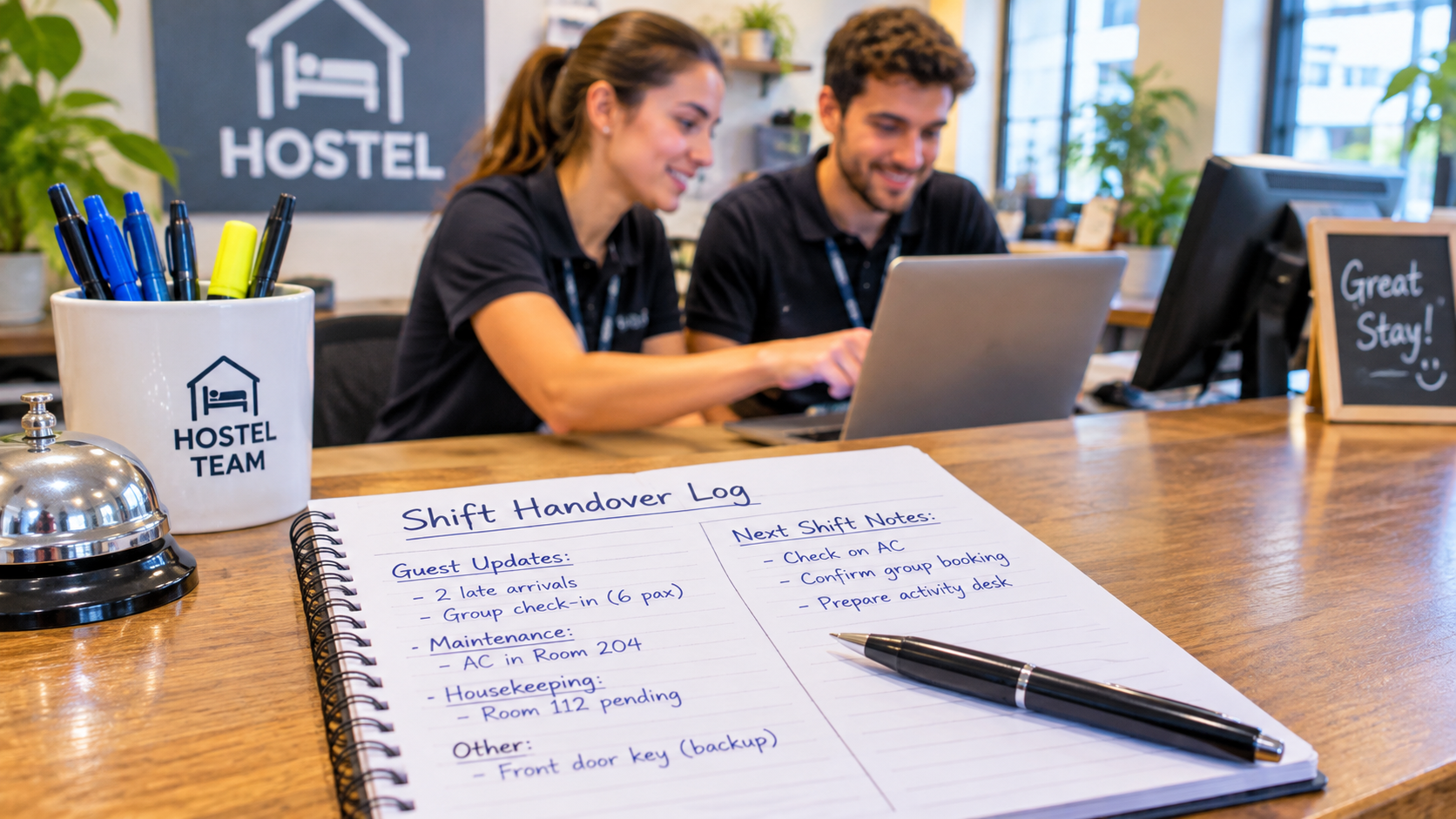
A physical notebook is one of the simplest ways to communicate between shifts.
Employees can write down important updates, guest concerns, maintenance problems, and instructions for the next team.
Advantages:
- Affordable and easy to implement.
- No internet connection required.
- Accessible to front desk employees.
- Useful for small hostels with limited staff.
Limitations:
- Notes can be overlooked.
- Handwriting may be difficult to understand.
- Information can be lost or damaged.
- Searching for older information can be time-consuming.
A notebook works best when there is a clear rule: every incoming employee must read it before starting their shift.
B. Property Management System (PMS)
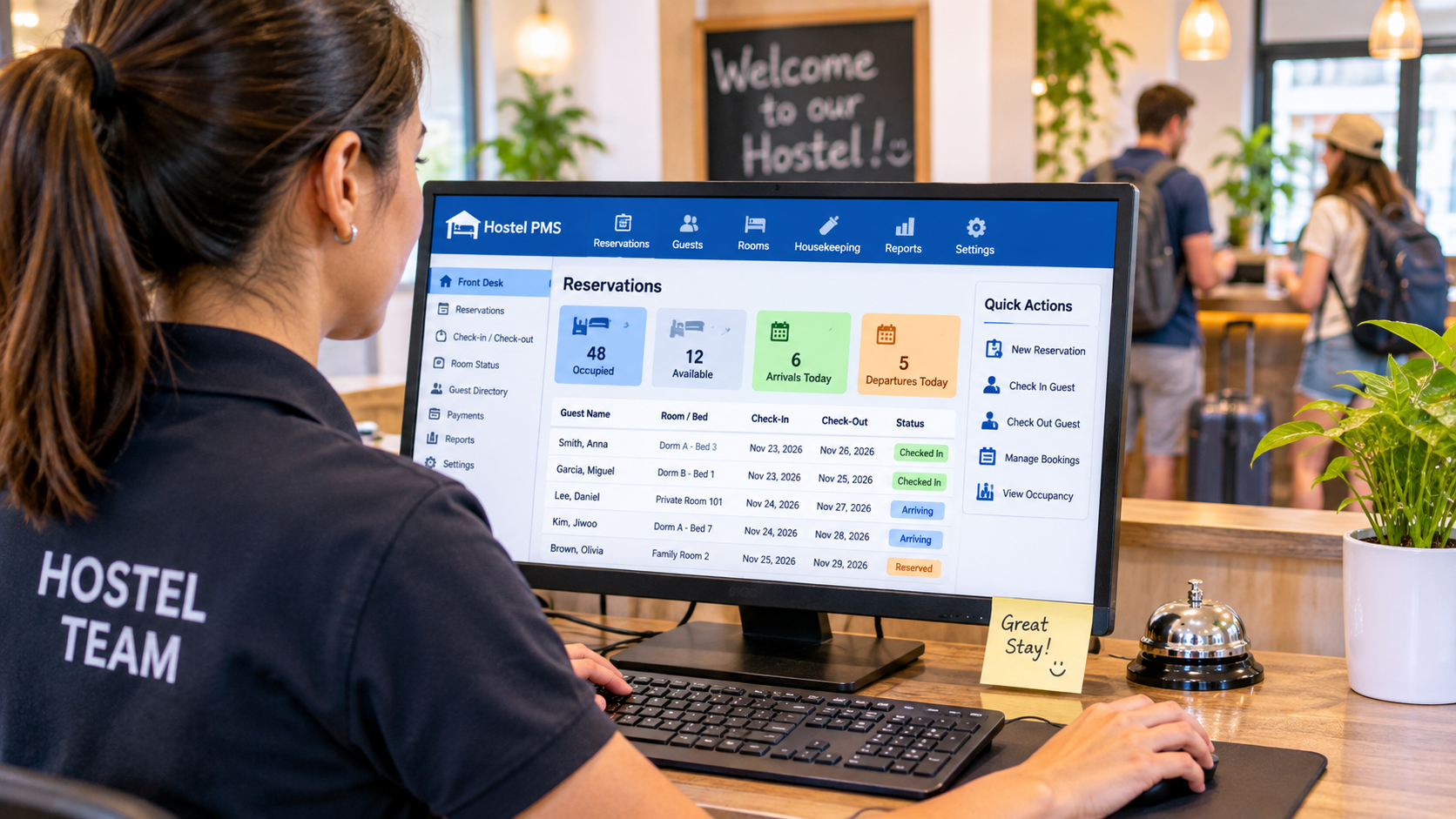
Some property management systems include internal messaging, reservation notes, maintenance logs, and housekeeping reports.
These features allow employees to record important information directly within the system they already use for daily operations.
For example, a receptionist can add a note to a reservation about a guest's late arrival or special request. Housekeeping staff can update room status, while managers can review outstanding tasks.
Advantages:
- Keeps operational information organized.
- Connects guest records with relevant notes.
- Reduces reliance on handwritten messages.
- Helps coordinate front desk and housekeeping activities.
Limitations:
- Features vary between PMS providers.
- Employees need proper training.
- Some systems charge extra for advanced functions.
Before choosing a PMS, ask whether it supports internal notes, task tracking, maintenance requests, and staff communication.
C. Email and Messaging Applications
<AsyncImage query="hotel hospitality team working on laptops communicating digital messaging office" aspectRatio="16:9" width="100%"/>
Email and messaging applications can help teams share announcements, updates, schedules, and urgent information.
For example, managers can use email for official announcements, while a dedicated team messaging platform can be used for day-to-day coordination.
However, separate conversations can become difficult to manage if employees use personal messaging accounts or multiple unorganized group chats.
Best practices:
- Create separate channels for departments when necessary.
- Keep operational discussions in approved work channels.
- Avoid sharing sensitive guest information in public or unsecured groups.
- Make important decisions and task assignments accessible in a central record.
- Establish expectations for response times.
Remember that urgent operational issues should not depend on someone checking their email or reading a message hours later.
D. Internal Staff Forum or Knowledge Base
An internal staff forum can be particularly useful for hostels with larger teams or multiple properties.
The original discussion highlighted an interesting advantage: an internal forum can become a searchable archive of staff instructions, recurring problems, and operational knowledge.
For example, employees can document:
- How to reset the Wi-Fi router.
- Where to find maintenance equipment.
- How to handle common guest complaints.
- Emergency procedures.
- Opening and closing checklists.
- Instructions for operating hostel facilities.
This reduces repetitive questions and makes it easier for new employees to learn from existing team knowledge.
An internal knowledge base can also help managers identify recurring problems and areas where additional staff training is needed.
4. Manage Maintenance Requests and Guest Complaints Properly
Maintenance issues and guest complaints should never rely solely on verbal communication.
Every issue should have a clear record, an assigned person, and a follow-up process.
For example:
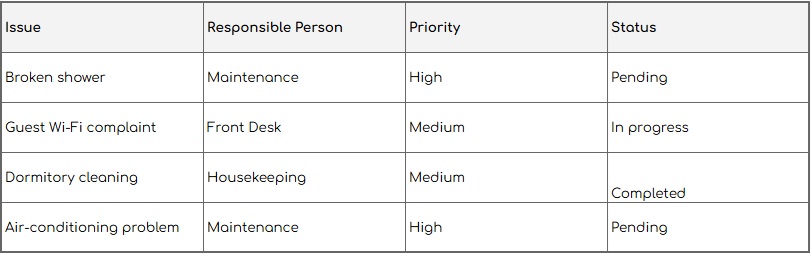
The exact priority levels will depend on the property, but urgent safety, security, and facility issues should always be escalated immediately.
A simple issue-tracking process:
- Record the problem as soon as it is reported.
- Identify the affected room, guest, or facility.
- Assign responsibility to the appropriate employee.
- Set a deadline or expected follow-up time.
- Update the status once action has been taken.
- Inform the next shift if the issue remains unresolved.
For guest complaints, staff should also document what was communicated to the guest and whether a solution or follow-up was promised.
This prevents guests from having to explain the same problem repeatedly.
5. Keep Teams Informed Across Different Shifts
One of the biggest communication challenges in hostels is having employees work at different times.
A morning receptionist may never directly meet the night receptionist. Housekeeping may finish before the evening team arrives, and maintenance may only be available during certain hours.
Without a structured communication system, important updates can easily get lost.
Consider implementing these practices:
Daily Shift Handover
Require outgoing staff to document pending tasks, guest concerns, operational updates, and important instructions.
Daily Team Updates
Managers can share a short daily update covering occupancy, group arrivals, special events, maintenance priorities, and staffing changes.
Weekly Team Meetings
Schedule regular meetings to discuss recurring problems, guest feedback, operational improvements, and upcoming activities.
Centralized Staff Information
Keep schedules, policies, emergency contacts, procedures, and important announcements in one accessible location.
Clear Escalation Procedures
Employees should know who to contact when an issue requires immediate attention, especially during overnight shifts or when managers are off-site.
For multi-property hostel businesses, centralized communication becomes even more important. Each property should have its own operational updates while management maintains visibility across locations.
6. Build Accountability and Better Teamwork
Communication is not just about sending messages. It's also about making sure people understand their responsibilities and follow through.
A strong communication system should answer three questions:
- What needs to be done?
- Who is responsible?
- When should it be completed?
Without these details, messages can easily turn into forgotten tasks.
Hostel managers can improve accountability through the following practices:
Assign Clear Responsibilities
Every task should have an owner. Avoid vague instructions such as "someone should check the broken lock."
Instead, assign the task to a specific employee or department.
Document Important Decisions
Verbal instructions can be useful for quick conversations, but important decisions should also be recorded in a shared system.
Encourage Employees to Speak Up
Staff members are often the first to notice operational problems. Encourage them to report concerns, suggest improvements, and share feedback without fear of unnecessary criticism.
Provide Regular Training
New employees should understand how to use communication tools, complete handovers, document complaints, and escalate problems.
Recognize Good Communication
When employees consistently provide accurate updates and support other departments, acknowledge their contribution. Good communication is a team responsibility, and positive reinforcement helps build the right culture.
7. Create a Simple Hostel Communication Policy
Every hostel should have basic guidelines explaining how employees are expected to communicate.
A simple policy can include:
- Which communication channels are approved for work.
- Where shift handover notes should be recorded.
- How maintenance requests should be reported.
- How guest complaints should be documented.
- Who should receive urgent escalations.
- How staff schedules and shift changes are communicated.
- Which information must remain confidential.
- How unresolved tasks are transferred to the next shift.
The policy should be easy to understand and accessible to all employees.
It should also be reviewed regularly as the hostel grows or changes its operating procedures.
Conclusion: Better Communication Creates Better Hostel Operations
A hostel can have excellent facilities, modern technology, and a talented team, but poor communication can still affect its daily operations.
The most effective communication system doesn't have to be complicated or expensive. A small hostel might operate perfectly well with a shared notebook and clear handover procedures, while a larger property may need a PMS, digital task management, and a centralized staff knowledge base.
What matters most is consistency.
Every employee should know where to find important information, how to report problems, and who is responsible for following up.
When communication becomes part of the daily routine, hostel teams can work more efficiently, resolve problems faster, and provide a more consistent guest experience.
Start with one simple improvement: make sure every shift leaves the next shift better informed than when they arrived.
Community Contributions: Thank You to Our HostelManagement.com Members
This article was inspired by the HostelManagement.com forum discussion, join the conversation:
Staff Communication: How Do You Do It? – General Hostel Operations
Originally started by Josh, the discussion invited hostel professionals to share how they communicate important information between employees and shifts.
We would like to recognize the members who contributed their experiences and practical ideas:
- Josh – Started the discussion and shared different communication approaches used in hostels, including notebooks, PMS messaging, email, and internal forums.
- Rucksack Brian – Shared how Post-it notes worked for a smaller hostel and described using a communication notebook to pass along guest complaints, special requests, maintenance problems, and important updates.
- santa klaus – Highlighted the benefits of an internal staff forum, including searchable information, archived instructions, staff schedules, and better management visibility.
Their contributions demonstrate that effective hostel communication doesn't always require complicated technology. Sometimes, a simple system used consistently can make a significant difference.
Thank you to our community members for sharing their knowledge and helping other hostel professionals improve their operations.
Downloadable Resource: Hostel Daily Shift Handover Template
Want to improve communication between your hostel staff?
Use a daily shift handover template to make sure important information is recorded and passed along to the next employee.
A good handover form should include:
1. Shift Information
- Date
- Shift (Morning / Afternoon / Night)
- Outgoing employee
- Incoming employee
2. Guest and Reservation Updates
- Expected arrivals and departures
- Guest complaints and special requests
- Group bookings
- Payment or reservation concerns
3. Housekeeping and Maintenance
- Rooms requiring attention
- Maintenance problems
- Pending repairs
- Cleaning updates
4. Outstanding Tasks
- Task description
- Assigned employee
- Priority
- Deadline
- Current status
5. Important Notes
- Management instructions
- Upcoming activities
- Staff updates
- Other information for the next shift
6. Handover Confirmation
- Outgoing staff confirmation
- Incoming staff confirmation
- Time of handover
A consistent handover process helps ensure that no important information gets lost between shifts.
Join the HostelManagement.com Community
How does your hostel communicate between shifts? Do you use a communication notebook, PMS messaging, WhatsApp, an internal forum, or a dedicated staff management platform?
We'd love to hear what works for your team!
Join fellow hostel owners, managers, operators, and industry professionals to exchange ideas, discuss operational challenges, and learn from each other's experiences.
Connect with hostel professionals: Join the HostelManagement.com Community