The short version: A cancelled bed is only a problem if you find out too late to resell it. Check cards early, report no-shows the same night, and write one cancellation policy your night shift can apply without calling you.
The size of the leak
Cancellations are not a rounding error. Cloudbeds' State of Hostels 2026 report, built on 32 million bookings, found that 20.7% of OTA hostel bookings were cancelled in 2025, against 9.2% of direct bookings. The same report puts OTAs at 73.7% of all hostel bookings and the average booking window at 24 days.
Put those together and the picture is uncomfortable: most of your bookings come through the channel where roughly one in five disappears, and they are made more than three weeks out, which is plenty of time for a traveller to change plans.
Illustrative example: a 40-bed hostel takes 600 bookings a month, 440 of them through OTAs. At the report's average rates, about 91 OTA bookings and 15 direct bookings cancel. Whether that costs you money depends entirely on how early you learn about each one.
Step 1: Write a policy a stranger could apply
Most hostels have a cancellation policy. Fewer have one that is identical on every channel and clear enough for a new night receptionist.
Decide and write down:
- The free-cancellation window. For example, free until 48 hours before arrival. Shorter windows mean fewer late cancellations but lower conversion on flexible travellers.
- The late-cancellation and no-show charge. One night is the common standard. Hostelworld's partner guidance describes the no-show fee on a standard booking as equivalent to the first night's stay, and the full cost on a non-refundable booking.
- When a guest becomes a no-show. Pick a time, for example midnight on the arrival date, and state what happens to the rest of the stay.
- Who can waive the fee. If the answer is "only the owner", the fee will be waived by default at 1 a.m.
Then load the same policy on every channel and on your own site. Mismatched policies are how guests win disputes.
Step 2: Offer a non-refundable rate
A non-refundable rate at a modest discount moves the cancellation risk to the guest in exchange for a lower price. It will not suit every traveller, and it should sit beside a flexible rate, not replace it. Track the share of bookings on each and the cancellation rate of each. If your flexible rate cancels at three times the rate of your non-refundable one, your discount is probably too small.
Our pillar guide on hostel revenue management covers how rate plans fit together.
Step 3: Check the card before arrival, not after
A guarantee card that does not work is not a guarantee. On channels where you charge the guest's card yourself, test it early.
For Booking.com reservations where the property collects payment, the process is built in. Cloudbeds' help centre explains that when you report a card as invalid, Booking.com notifies the guest and gives them a set time to update it (24, 12 or 2 hours, depending on the booking conditions) before you can request a cancellation. It also notes this applies only to reservations where the hotel collects payment, not those where Booking.com does.
The practical routine:
- Each morning, pull arrivals for the next three to seven days.
- Pre-authorise or validate cards on flexible bookings, following your payment processor's rules.
- Report failures as invalid through your PMS or the extranet straight away.
- If the guest does not fix it in the allowed time, cancel and resell the bed.
Done a week out, this gives you days to resell. Done at midnight on arrival, it gives you nothing.
Step 4: Report no-shows the same night
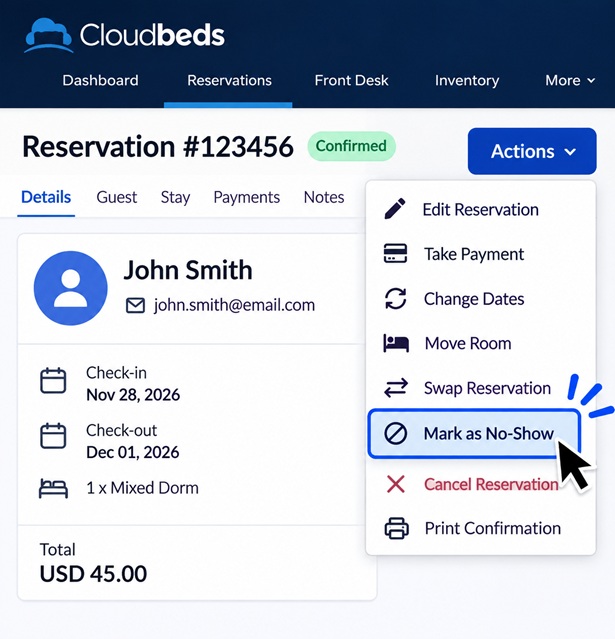
A no-show you do not report is a booking you may still pay commission on. Several channel managers document the Booking.com process. Rentals United's guide notes that cancellations are tracked automatically but no-shows have to be reported, and that if you agree to waive the cancellation fee you are not charged commission on that booking.
On Hostelworld, the no-show article adds two details worth training on:
- Card details are stored only until seven days after the scheduled check-out date, so charge promptly.
- For a multi-night booking, cancel the remaining nights so you can resell the beds.
Make "report no-shows" a line on the night shift closing checklist, with the cut-off time written next to it.
Step 5: Message guests before they vanish
Many no-shows are guests who changed plans and never told you. A short message 48 to 72 hours before arrival, asking for an arrival time and reminding them of the free-cancellation deadline, converts silent no-shows into cancellations you can resell. Keep it friendly and make cancelling easy. You want the bed back more than you want the fee.
Operators on our forum have used reconfirmation emails this way for years. See the long-running thread on charging no-shows from Hostelworld and Hostelbookers bookings.
Step 6: Overbook only with rules
Deliberate overbooking is standard practice in hotels and risky in hostels, where walking a guest at 11 p.m. usually means a one-star review. If you do it at all:
- Base it on your own no-show rate by channel and season, not a guess.
- Cap it low, one or two beds on a 40-bed property, and only on dates where your history supports it.
- Never overbook private rooms or female-only dorms, where you have no like-for-like substitute.
- Agree in advance where a walked guest goes and who pays.
If you cannot answer the last point, do not overbook.
What to measure
Add four numbers to your weekly revenue meeting:
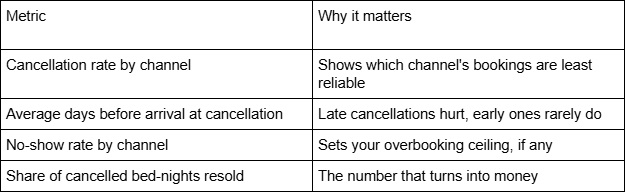
The last one is the real target. A hostel that cancels 20% of bookings and resells most of them is healthier than one that cancels 10% and resells none.
Putting it together
You will not stop travellers changing plans. You can decide how early you find out, how fast the bed goes back on sale, and whether your team knows what to do without asking. That is a checklist problem, and checklists are cheap. Compare notes with other operators on the Hostel Reviews, Booking Engines, and Directories board, and see our numbers on channel cost in Direct Booking vs OTA: Real Margin Math for a 40-Bed Hostel.