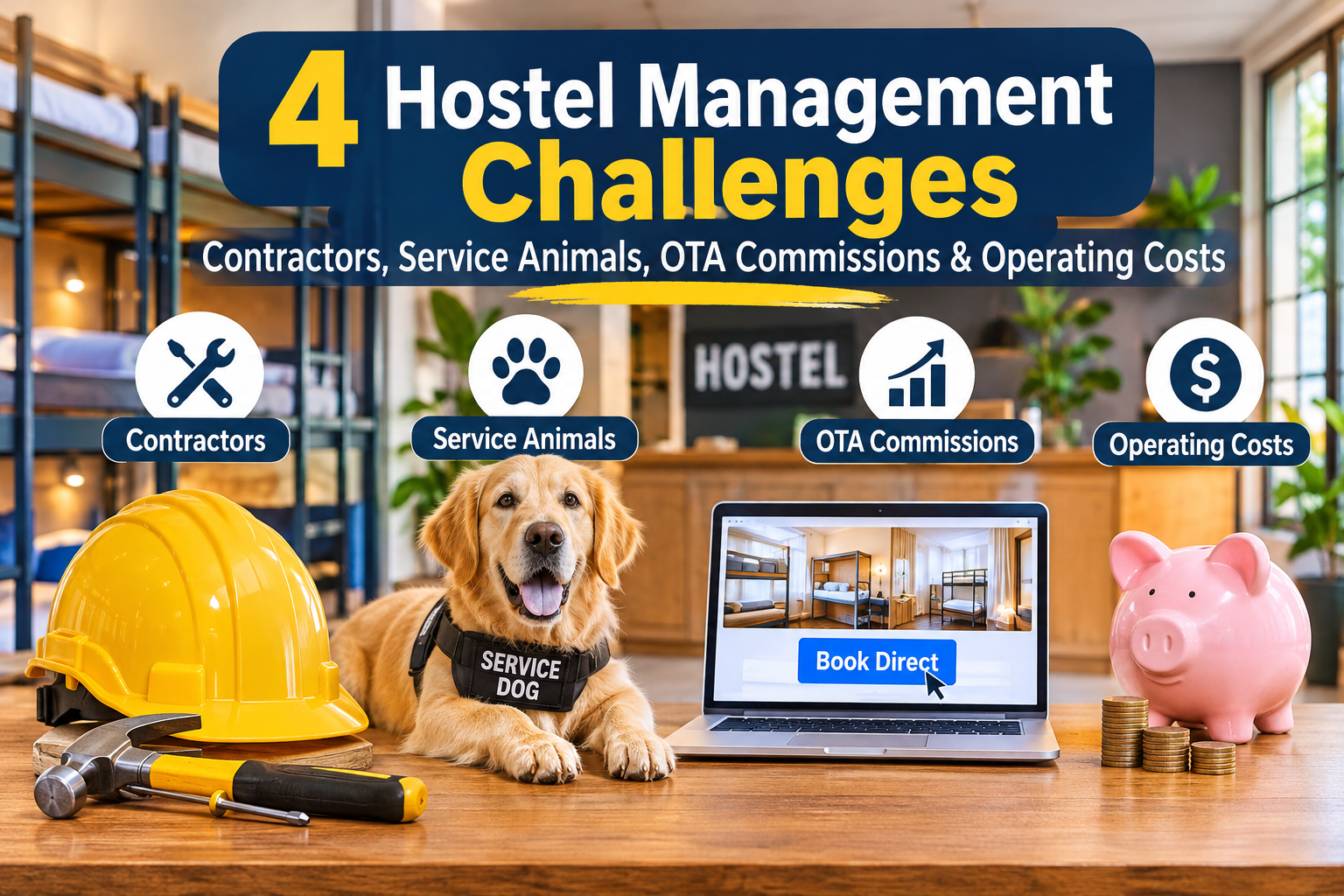
Running a successful hostel involves more than providing beds and creating memorable guest experiences. Behind every well-managed property are countless operational decisions, from hiring reliable contractors and maintaining facilities to managing booking platforms and controlling expenses.
In a recent episode of Weekly Hot Takes – Hostel Management News & Hacks, Sean Barrite, Bobby Dyer, and James Black discussed four important challenges facing hostel operators today: finding trustworthy vendors, handling service animal policies, navigating rising OTA commissions, and purchasing quality equipment without overspending.
Their conversation offered practical lessons that hostel owners and managers can apply to improve their operations and protect their businesses.
1. Finding Reliable Contractors: Start Small and Do Your Research
Finding trustworthy contractors and maintenance professionals can be challenging. Prices, experience levels, and the quality of work can vary significantly.
One important recommendation from the discussion was to start with smaller projects before committing to larger contracts. This allows operators to evaluate a vendor's reliability, workmanship, communication, and pricing before trusting them with more expensive work.
James also emphasized the importance of looking within your existing team. Some staff members may already have practical skills that can be used for maintenance and other operational responsibilities.
Self-education is another valuable investment. Learning basic repair skills, such as maintaining washers and dryers, can save thousands of dollars over time. With resources like YouTube and ChatGPT, operators now have more opportunities to develop practical maintenance knowledge.
Key takeaway: Build relationships with reliable contractors, evaluate their work carefully, and invest in developing your team's skills.
2. Service Animals: Protecting Guest Rights and Maintaining a Safe Environment
Service animals can present operational challenges for hostels, particularly when properties have shared dormitories and communal spaces.
The speakers discussed concerns about improperly trained animals, guest disturbances, and potential legal disputes involving service animal accommodations.
James highlighted the importance of staff training, particularly for reception teams who regularly communicate with guests. He explained that staff members should receive proper training before handling these situations independently.
Bobby also discussed the idea of using a service animal agreement to communicate expectations regarding animal behavior, supervision, and responsibility within the property.
However, hostel operators must ensure that their policies comply with applicable disability and accessibility laws. In the United States, for example, ADA rules generally limit the questions businesses may ask about service animals and do not permit blanket requirements for certification or documentation.
Key takeaway: Train your staff, establish clear and legally compliant procedures, and make sure everyone understands how to handle service animal requests professionally.
3. Rising OTA Commissions: Why Direct Bookings Matter More Than Ever
Online Travel Agencies (OTAs) remain important marketing and distribution channels for hostels, but increasing commission rates are putting additional pressure on independent operators.
The discussion highlighted Hostelworld's reported commission increase of up to 17.7%, illustrating the growing costs associated with third-party booking platforms.
While OTAs provide access to a large audience, operators need to develop strategies that reduce their dependence on these platforms.
Bobby emphasized the importance of increasing direct bookings through stronger guest relationships, word-of-mouth marketing, and creating unique hostel experiences.
James raised another important issue: not every booking platform is suitable for the hostel business model. Hotel-focused platforms may attract travelers who do not understand shared dormitory accommodations or the social nature of hostels.
Accurate and transparent listings are therefore essential. Operators should clearly communicate that their property is a hostel and explain the accommodation experience to manage guest expectations.
Key takeaway: Build a direct booking strategy, choose distribution channels carefully, and make your OTA listings transparent and accurate.
4. Buying Hostel Equipment and Decor Without Overspending
Maintaining quality while controlling expenses is another ongoing challenge for hostel operators.
The speakers recommended testing products before purchasing them in large quantities. Instead of ordering hundreds of bunk curtains, mattresses, or other supplies immediately, operators should purchase samples and evaluate their quality first.
James suggested involving on-site staff and work-exchange members in product testing. Their feedback can help identify practical issues before a larger investment is made.
Bobby added that hostel operators should prioritize commercial-grade equipment whenever possible because residential products may not withstand the constant use and wear and tear of a busy hostel.
He also recommended conducting regular property audits to identify maintenance needs and ensure that the actual guest experience matches what is advertised online.
Most importantly, operators should prioritize spending where guests spend the most time: their beds and rooms. Comfortable mattresses, functional bunk beds, and quality room amenities can have a greater impact on guest satisfaction and extended stays than expensive decorative upgrades.
Key takeaway: Test before buying, invest in durable equipment, conduct regular property audits, and prioritize improvements that directly affect guest comfort.
What This Means for Your Hostel
The discussion reinforces an important lesson: successful hostel management requires smart decisions, proactive maintenance, and continuous improvement.
Here are four practical actions operators can start implementing:
- Review your vendors: Evaluate existing contractors, compare prices, and test new vendors with smaller projects before assigning major work.
- Train your staff: Establish clear procedures for handling service animal requests and other sensitive guest situations.
- Review your booking strategy: Monitor OTA commissions, improve your direct booking channels, and make sure your property descriptions accurately reflect the hostel experience.
- Audit your property: Review equipment, furniture, bunk beds, and guest amenities regularly to identify improvements and prevent unnecessary expenses.
Ultimately, running a sustainable hostel is about balancing operational costs with guest satisfaction. Investing in the right people, systems, equipment, and booking strategies can help operators build stronger businesses while delivering better experiences.
Watch the Full Discussion
Catch the complete conversation with Sean, Bobby, and James in this episode of Weekly Hot Takes – Hostel Management News & Hacks.
YouTube: https://www.youtube.com/watch?v=7YfiA52PIsI